
It was day seven of the 2010 World Snooker Championship, in the second round, and Neil Robertson was starting to panic. He was 6-0 down to the bespectacled assassin Martin Gould, a man so inconsistent as to be positively dangerous. Gould had already knocked out the eighth seed, Marco Fu, and he was well on his way to killing off the ninth seed too.
“Crowds love seeing an underdog win,” recalls Robertson. “He really thrived off that. He just completely went for it and everything was flying in. He was unplayable.”
Robertson travelled back to his rented room that night trailing 11-5 in their race to 13 frames. The apartment owner asked if he’d be needing another week’s stay. “I said not to bother. The next day I packed all my bags, checked out, and I rocked up to the Crucible with it all in the car ready to go.”
The crucial intervention came from a friend and body-language expert who suggested Robertson try something new. “He drilled it into me to have the positive body language and aura as if you’re the one who’s 11-5 up. So I tricked my mind into thinking that. And I think that was probably a bit of a shock to Martin.”
Chest out, Robertson won the next four frames and Gould’s game began to crumble. They went to 12-12 and a deciding frame, where Robertson knocked in a long do-or-die pink which Stephen Hendry described on commentary as one of the best pressure balls he’d ever seen.
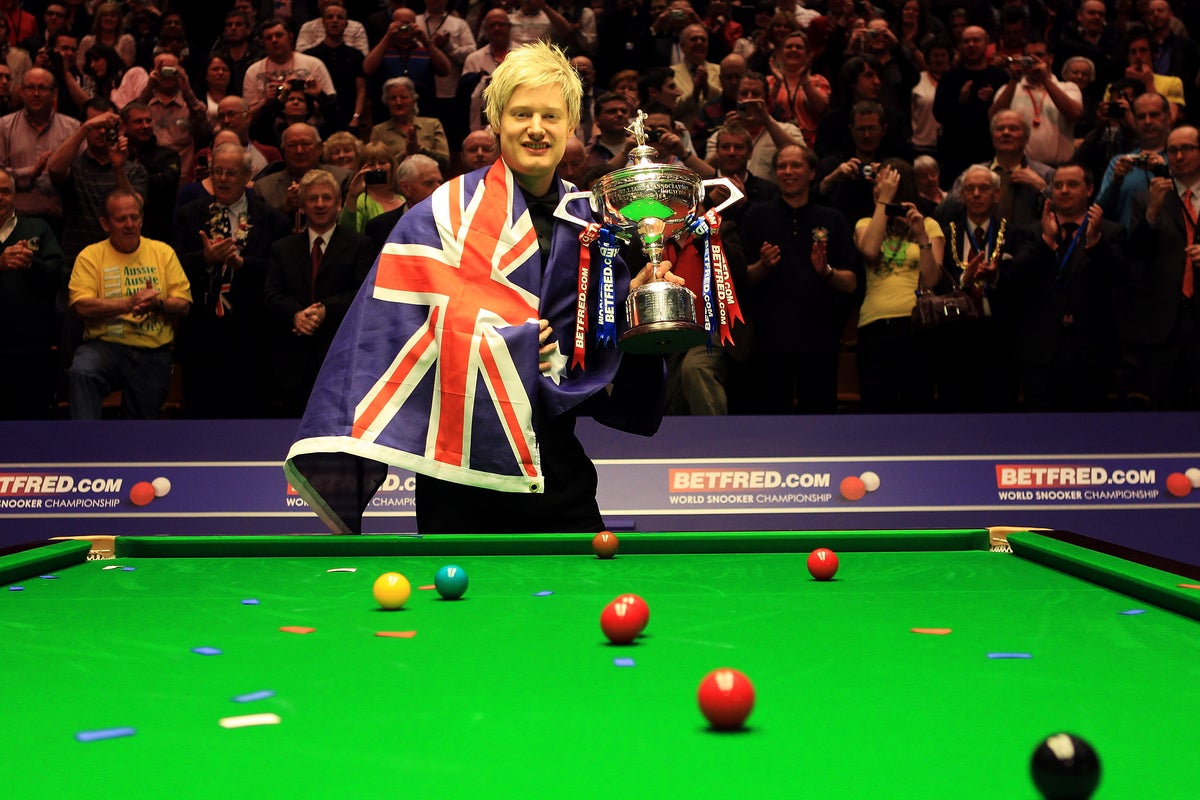
Robertson carried that confidence all the way to the trophy, sweeping aside Steve Davis, Ali Carter and Graeme Dott to become the only Australian to win the world title in the modern era.
He remains one of snooker’s deep thinkers, a player who treats the game like a high-performance sport, for which 17 days inside the Crucible Theatre is its purest test. Roberston pores over stats and analyses past frames in detail. Psychology is part of the contest. Cardio, strength and a vegan diet are as important to his training regime as potting balls.
“I think that’s been the key to how I’ve been able to improve a lot over so many years, I always look for any little advantage I can get,” he says.
A drop-off in results between 2022 and 2024 saw Roberston tumble from fourth in the world to No 28. He stripped back his game, put trust in his natural cue action over technical tinkering, and crucially he sought help on snooker’s mental demands. At 44 he is a player reborn, winning three ranking titles over the past 18 months to climb back to world No 3 before this year’s World Championship.
For the first time in his career, Robertson has assembled a specialist support team around him. They include Joe Perry, who works on his match-play strategy, and Helen Davidson, his sports psychologist.
“I’m very excited for the World Championship because it’s the first time we’ve had a team meeting and come up with a really structured plan about how I’m actually going to be playing,” Robertson says, speaking to The Independent at the Crucible. “This is the first year talking with the whole team about, ‘This is the plan for the tournament – are you OK with it? OK, yes, we’re all in this together’, like any top golfer, any top tennis player.”
A 10-4 defeat by Judd Trump in the Tour Championship semi-finals earlier this month triggered an urgent team meeting and a chance to recalibrate the dials.
“It was a dreadful match, we both were terrible, and it was certainly played on the terms that he was playing on. In longer matches, especially in the World Championship, someone can start bogging it down a bit – I use a football term, parking the bus – just not playing the way I like to play. So our idea is hopefully going to swing things more in my favour, where it’s going to lend itself to a lot of attacking snooker and a lot of big breaks, which is what I want to be involved in.”
Robertson is a rare find in the world of snooker: a player in the world’s top echelons who is not British or Chinese. He is the only player in the top 100 from outside Europe and Asia – you have to go down to Egypt’s Hatem Yassen and Brazil’s Jonas Luz to find the next on the list, at No 114 and 115.
He learnt the game in his parents’ snooker club before moving to Leicester, aged 19, to follow his dream of becoming a professional player. But swapping Melbourne for the Midlands – in November – was quite an experience.
“Boy, was that a shock to the system, living in Leicester in those winter months. I got really homesick, and I was even questioning whether or not I wanted to be a snooker player, because I wasn’t too sure how much I would enjoy waking up in darkness and then going to a snooker club to practice, and then I walk out and it’s dark, and it seemed like I was just experiencing darkness for four or five months. I was pretty depressed, especially being a young person coming from Australia and not really knowing anybody.”
Robertson went home and worked in a bar, but the fire relit when he won the Under-21 World Championship in New Zealand two years later. He returned to the UK, this time to Cambridge, where he met Perry and struck up a friendship. “No disrespect to Leicester, but Cambridge is a pretty nice place to live so I got really lucky there. I had access to a world-class player, world-class facilities and I haven’t looked back since.”
He has won two Masters and three UK Championships among nearly 30 titles, alongside his World Championship triumph and several spells as world No 1, the fruits of a hugely successful career in a highly competitive era against snooker’s class of ‘92 and a surge of Chinese talent.
Yet even so, there is a nagging feeling that one world title does not quite do Robertson justice. There have been some near misses, like his quarter-final with Ronnie O’Sullivan in 2012. “That’s probably as close to unbeatable as I think I’ve ever seen anyone at the World Championship,” he says. “I gave him a good run for his money as well. I remember being 5-3 up, but I remember him coming back at me in that second session like an absolute steam train, and the crowd were with him as well. When Ronnie’s playing great here, it’s very hard to stop.”
Two years later, Robertson was world No 1 and brimming with confidence, but he lost an epic semi-final with Mark Selby, going down 17-15. He has not made it back to the one-table format in the decade since, but his form this season is enough to suggest that barren run could end over the next two weeks.
“My weakness here has probably been that I can get drawn into a middle session that doesn’t really seem to be going anywhere, and before I know it the session is taken away from me,” he says, which is why he and his team come into the tournament with a strategy. He begins against Pang Junxu on Wednesday, with O’Sullivan a potential opponent in the quarter-finals.
“This year the emphasis is going to be very attacking. I’ve got a certain plan about how I’m actually going to be doing that, which is hopefully going to impact a lot of the frames in my favour. I think this is the most confident I’ve been probably ever coming into the World Championship, because I feel as though as a collective we’re in this together, and this is the set plan, and I’m not going to deviate from it.”