

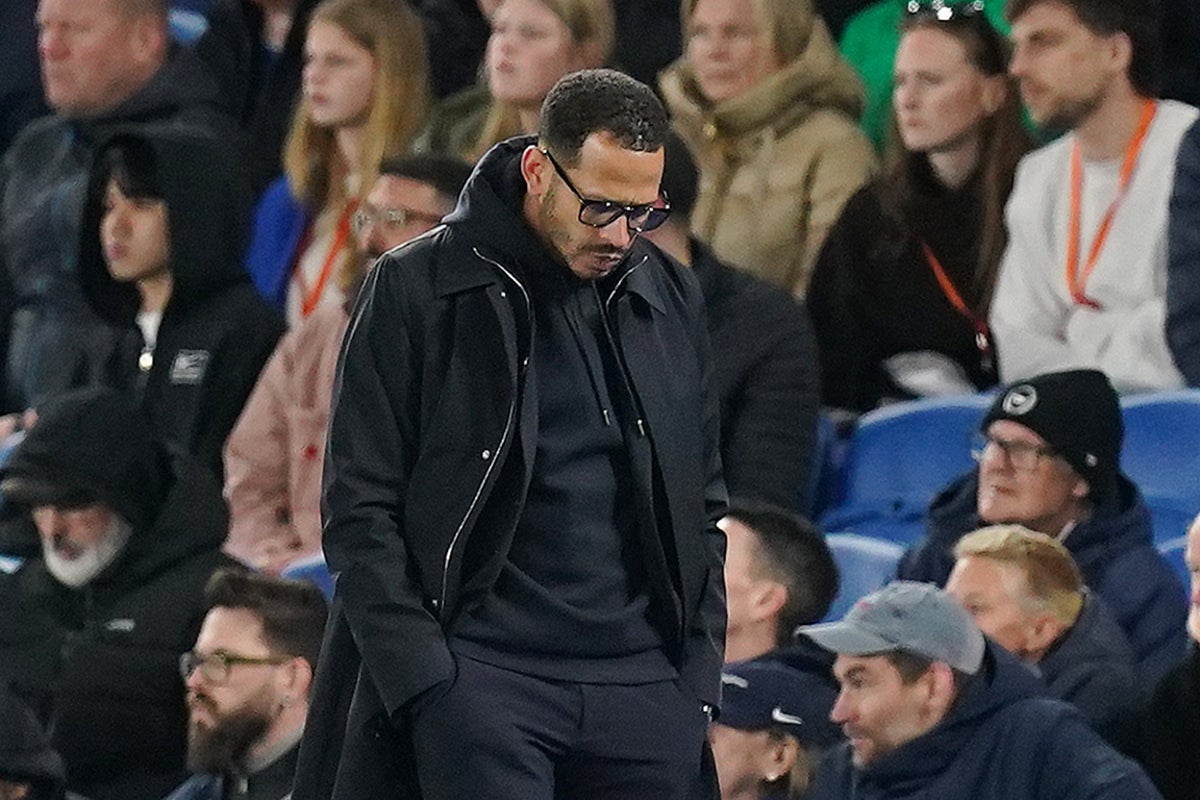
So now Liam Rosenior’s LinkedIn profile requires updating. The manager given the cruel moniker of ‘LinkedIn Liam’ may struggle to spin a three-and-a-half month spell at Chelsea into a learning experience that leaves him ready for his next challenge. Rather, it must have been a horribly bruising experience. Rosenior did not even enter the last five years of his five-and-a-half year contract at Stamford Bridge. Though not the shortest managerial tenure in his family, after his father Leroy’s 10 minutes in charge of Torquay in 2007, his 23-game reign gave him the shortest tenure of any supposedly permanent head coach in Chelsea history.
The risk is the permanent element is the harm done to Rosenior. Chelsea’s surrender at Brighton, coupled with their tactical incoherence as he switched to a 3-5-2 formation, amounted to an advertisement for change. His own verdict – “indefensible” and “unacceptable” – highlighted his inability to get a performance from his players. His team failed to make a tackle in the first half hour, went a fifth straight league game without scoring and, after being on course for Champions League qualification, could now get a bottom-half finish.
And yet Rosenior merits sympathy. He can be seen as an architect of Chelsea’s slide. It may be more accurate to see him as a victim of their owners’ incompetence and arrogance. The 41-year-old was presented with an offer which, realistically, he could not refuse. In the process, he was plunged into a post for which, it soon became apparent, he was not ready.
Rosenior had shown genuine promise over his time at Derby, Hull and Strasbourg. A fine young coach and intelligent thinker – though he could do with again becoming the eloquent communicator he was when a pundit on the Football League and ditching the meaningless managerial jargon that brought his unwanted nickname – he seemed to have the potential to gravitate to still bigger jobs.
But plunging him in this soon backfired. With another few years learning his trade, Rosenior could have had more experience and a bigger reputation; more credibility with big-name players and a fanbase who never wanted him, either. Enzo Fernandez’s recent dissent felt an indication that he did not really rate Rosenior; perhaps, until a few months ago, he had never heard of him. If so, he may not have been alone in that in the Chelsea dressing room. While part of choosing managers can involve identifying those with ability, it seems safe to say that Rosenior would not have been appointed by any other superclub this soon. Now perhaps he never will be: he has been tarnished by failure at Chelsea.
In opting for Rosenior, like Enzo Maresca before him, BlueCo showed they have tried to downgrade the manager’s role; Maresca’s eventual unravelling proved he was not content to be their ‘yes man’ and Rosenior had to reject suggestions he was. Yet in looking for figures of lesser pedigree, they have sought to avoid anyone who could have an alternative powerbase. One very evident flaw in their thinking is that BlueCo’s own work has been so poor, their much-mocked transfer business too expensive and too unsuccessful, to provide a case why they know best.
Another is that results can still depend to a considerable degree on the manager. They still matter, especially in match-ups. Rosenior had a 100 percent record against three of the elite, in Mikel Arteta, Luis Enrique and Pep Guardiola. He lost every game. He lost, too, to David Moyes, Eddie Howe and, in his final match, Fabian Hurzeler. He beat Oliver Glasner, Antonio Conte and Unai Emery but wins over Crystal Palace, Napoli and Aston Villa were arguably his only genuinely good results.
Now a problem for Rosenior is that he risks being defined by his misadventures at Chelsea. He would not be the first. Graham Potter’s career was on an upward trajectory until he, too, was plucked by Todd Boehly and Clearlake Capital, also looking unsuitable for Chelsea. Potter has belatedly found a job to suit him with Sweden but may be unemployable in the Premier League. Frank Lampard was out of work for 18 months after his second, ill-fated stint with Chelsea. His appointment at Coventry met with plenty of scepticism. Time will tell when and where Maresca resurfaces.
In the meantime, there are suggestions Chelsea could look for a more experienced replacement for Rosenior; Andoni Iraola and Glasner will be available in the summer, Marco Silva may be and Xabi Alonso already is. Yet would any of them take the plunge?
Many a high-calibre candidate could be deterred by both Rosenior’s fate and the constant chaos at Stamford Bridge. They might not want to work for BlueCo. If so, it is a fate that Boehly and Clearlake deserve. The danger is that others are broken by their mismanagement. It is to be hoped that Rosenior does not prove collateral damage from this ridiculous project.