
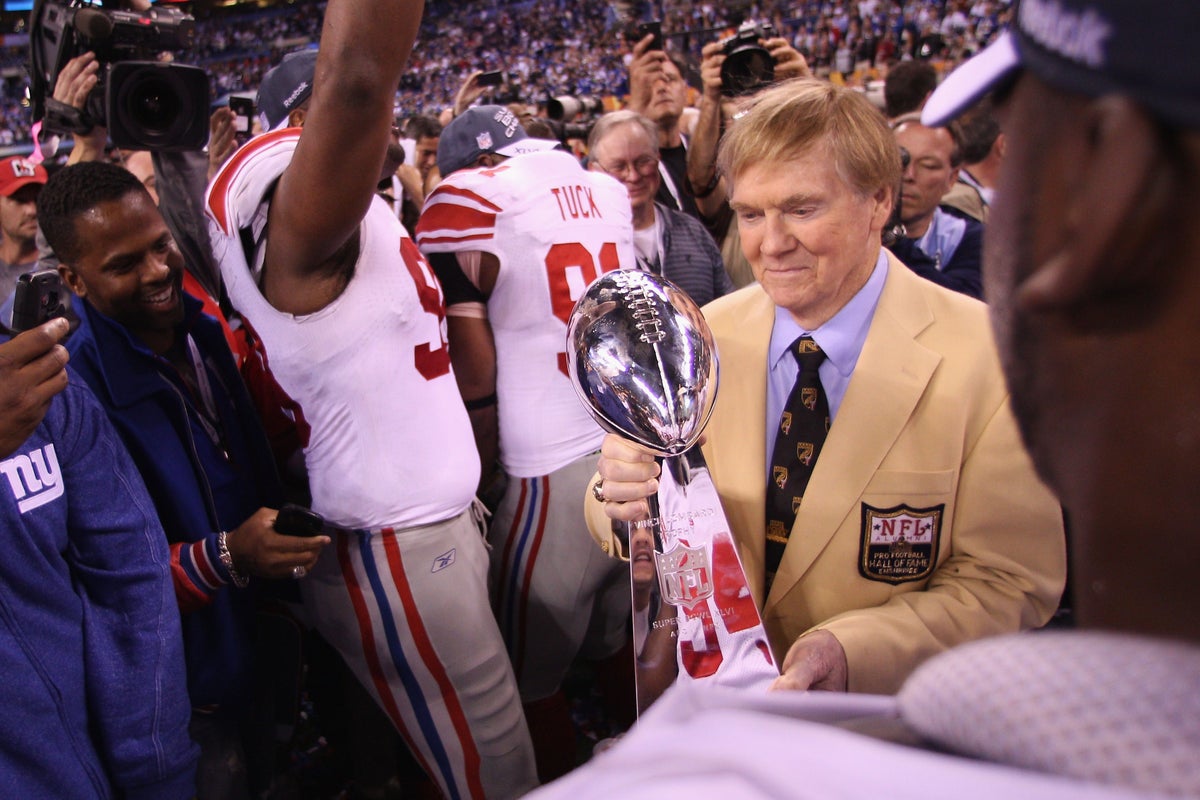
Raymond Berry, the legendary Hall of Fame wide receiver whose telepathic connection with quarterback Johnny Unitas forged one of American football’s most formidable passing duos, has died at the age of 93.
Berry, a pivotal figure in the Baltimore Colts’ historic 1958 championship victory over the New York Giants, passed away on 25 May, the Pro Football Hall of Fame announced on Monday.
His family confirmed in a statement that Berry died peacefully at his home in Murfreesboro, Tennessee, surrounded by loved ones, including Sally, his wife of 65 years.
A 20th-round draft pick from Southern Methodist University (SMU) in 1954, the Texas native embodied the virtues of relentless hard work and unwavering determination. Despite possessing average speed, legs of differing lengths, a troublesome back, imperfect eyesight, and oversized feet that earned him the high school nickname “Skis,” Berry transformed himself into a superstar. His ascent was fuelled by exhaustive preparation, from strengthening his fingers with Silly Putty to meticulously simulating entire games during practice.
He was renowned as one of the most reliable receivers in league history, rarely dropping a pass and fumbling only twice throughout his career, according to Pro Football Reference.
Berry himself claimed to have developed 88 distinct routes to get open, a level of discipline so intense that even his coach, Weeb Ewbank, once tried to intervene.
“One of his drills was to throw nothing but bad balls to him,” Ewbank told the Los Angeles Times in 1986. “I used to have to run John (Unitas) off — ‘John, you’ve had enough throwing today’ — and he’d say, ‘Yeah, talk to that guy out there.’”
Over 13 seasons, Berry amassed a then-record 631 receptions (a mark since surpassed by Jerry Rice), scoring 68 touchdowns. He led the NFL in receptions three times and earned six Pro Bowl selections.
A cornerstone of one of the league’s premier offences, alongside Unitas, running back Lenny Moore, and offensive lineman Jim Parker, Berry played on championship-winning teams in 1958 and 1959, and was a runner-up in 1964.
He was inducted into the NFL Hall of Fame in 1973 and was named to the league’s 50th and 75th anniversary teams. The Colts retired his uniform number, 82, while SMU retired his college number, 87.
Berry’s performance in the 1958 championship finale against the Giants at Yankee Stadium remains legendary. This overtime classic, nationally televised, is often cited as one of the sport’s greatest games and a catalyst for the NFL’s subsequent rise. Against the NFL’s toughest defence, Berry caught 12 passes for 178 yards and a touchdown, including three consecutive receptions during the 86-yard drive that tied the game 17-17 in regulation. He then made two crucial grabs during the 80-yard drive that secured the Colts’ 23-17 victory, the league’s first championship to conclude in overtime.
“We worked and got to know each other and developed timing you just can’t get any other way,” Berry later told the radio programme Sports & Torts. “He (Unitas) knew I was going to be there when I was supposed to be there and he knew I was going to catch it.”
After retiring as a player in 1967, Berry transitioned to coaching, serving as a wide receivers coach for the Dallas Cowboys, Cleveland Browns, and New England Patriots.
He took the helm as head coach of the Patriots from 1984-89, achieving a 48-39 record, including an 11-5 season in 1985 that led to an appearance in Super Bowl XX. However, the Patriots suffered a crushing 46-10 defeat to the Chicago Bears.
Following this, the Boston Globe revealed that several New England players had drug problems, with Berry acting as a source for the story. His subsequent push for the team to implement drug testing was met with strong opposition from the NFL players’ union.
A deeply religious man who abstained from alcohol and tobacco, Berry’s advocacy for drug treatment stemmed from personal experience. His former Colts teammate, All-Pro defensive tackle Gene “Big Daddy” Lipscomb, had struggled with addiction.
“They didn’t help him, they just cut him,” Berry told The Patriot Ledger in 1986. “Three years later, he was dead.”
Born in Corpus Christi in 1933, Berry married fellow Texan Sally Crook in 1960, and they had three children.
He credited some of his success to his high school coach, his father Mark Raymond Berry, who taught him the fundamentals of football despite not playing him extensively. After a year at Schreiner College, he transferred to SMU, where two fumbles in a crucial game spurred a vow never to repeat such mistakes in the professional ranks.
His rookie season with the Colts saw him catch only 13 passes, but the following year, the team signed a free agent quarterback cut by the Pittsburgh Steelers – Unitas. The two soon began their practice sessions.
“I didn’t know my butt from first base about how to run pass routes,” Berry recalled to Sports & Torts. “If you saw both of us in training camp in 1956, you may have gone away sobbing. We were two pitiful football players, good grief.”