

With nearly 1 million fans set to descend on Mexico for the World Cup, Fifa has vowed that the world’s most-watched sporting competition will pass seamlessly.
But violent clashes in the country sparked by the death of a drug lord earlier this year were a stark reminder of the powerful cartels that have long caused chaos in Mexico.
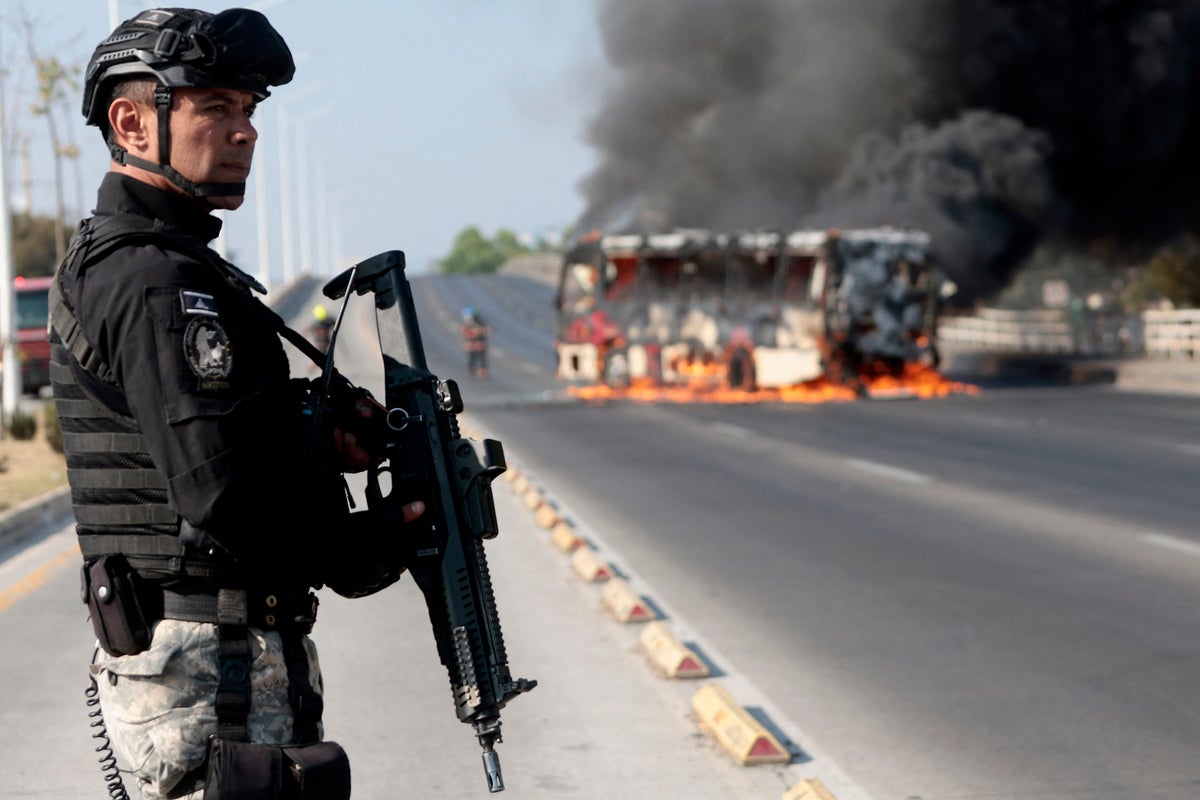
In February, Jalisco state authorities declared a state of emergency hours after Mexican security forces killed Nemesio “El Mencho” Rubén Oseguera Cervantes, the formidable leader of the Jalisco New Generation Cartel (CJNG).
Cartel militants responded with a destructive campaign of violence across the country, taking ferocious revenge for the killing of El Mencho.
During the rampage they set fire to cargo trucks and buses to create roadblocks. Over two days, 30 government agents and a similar number of cartel members were killed.
Four months later and the Jalisco state city of Guadalajara is one of the key Mexican locations due to host the tournament, which is being shared with the United States and Canada.
A Fifa spokesperson told The Independent that it is confident that the government will “ensure a safe, secure, and welcoming environment”, with president Claudia Sheinbaum set to deploy 100,000 troops across the host cities.
It is all part of Mexico’s Plan Kukulkan, an ambitious and large-scale strategy to guarantee security through deep cooperation between multiple arms of Mexico’s security apparatus.
The plan, named after a feathered serpent deity in Maya mythology, will see dozens of federal, state and local agencies work together to guarantee safety around Mexico’s stadiums, training facilities, transport hubs and tourist sites.
The expanded coordination between federal and local agencies could even benefit Mexico’s fight against organised crime after the World Cup comes to an end, experts say.
But Guadalajara’s chilling history still looms. In early 2025, a mass grave containing more than 250 bags of human remains was discovered just 13 kilometres from the host stadium.
Mexico City, another host city, saw a significant escalation in violence last year, in part a product of Sheinbaum’s escalating confrontation of the cartels.
Around 276 organised crime violence events were recorded by conflict analysts ACLED, the most since 2019. That is a 53 per cent increase on 2024.
Will striking teachers impact the World Cup?
Aside from the more obvious threat of gang-related violence, concerns have been raised about the impact of strikes in Mexico.
Teachers have threatened severe disruption to the tournament and may pose more of a practical problem for authorities in the coming weeks.
On Tuesday, striking teachers sparked chaos in downtown Mexico City, with protesters felling huge mannequins of football players, setting footballs alight and blocking main roads all across the capital. They were met by rubber bullets and tear gas from Mexican riot police.
Chris Sabatini, director of the Latin America programme at Chatham House, said the union behind the strike could well cause problems during the tournament.
“It has basically undermined the entire Mexican educational system, and they’ve threatened to hold strikes to close off routes that would allow fans to go to the games,” he says.
Associated with the CNTE union, the teachers are demanding salary increases and a reversal of pension reforms, threatening to protest throughout the tournament if a solution is not reached. So their chants go: “If there is no solution, the ball won’t roll”.
Tiziana Breda, a senior analyst for Latin America at ACLED, says: “Many sectors, including teachers and civil society groups, are indeed likely to use the attention brought by the world cup to shed light on their grievances, spanning from salary increases to requests for a government response to crime and forced disappearances.
“So public order could be an issue, and indeed we’ve recorded an increase in protests in both Monterrey and Mexico City this year.”
Cartels wind down violent activity
Experts have said that despite the headline grabbing nature of drugs gangs, the cartels may not have as a great an impact on the World Cup as feared, if only out of their own self interest.
In fact, the cartels themselves actually appear to be slightly scaling down their violent activities ahead of the World Cup, as they look to exploit the boost to the local economy.
In the first five months of 2026, incidents of organised crime violence in Guadalajara dropped 30 per cent from the previous five months. Monterrey saw a fall of 13 per cent in the same period.
The cartels are deeply embedded into local economies, so an escalation before or during the event could damage the amount of cash they take in.
Cartel bosses often own local businesses, otherwise they will “extort literally large swaths of the restoration, accommodation, public transportation sectors that benefit from a greater flow of tourists”, says Breda.
“We are not recording particular increases in violence against civilians or clashes with the state or between armed groups, quite actually the contrary,” he continued.
“More violence would make more people shy away from attending, and that will mean fewer revenues for these group.”
However, the risk always remains given the fierce competition for tourist dollars.
“Restaurant, hotels, parking lots, merchandise, fake merchandise sales, anything that has to do with the World Cup will certainly attract an interest, and so may generate violence if people do not abide by the rules imposed by these groups,” Breda said.
Could violence explode post-World Cup?
Experts have warned there is also a risk that violence could resume after the 39 day tournament even if the World Cup itself is relatively trouble free.
Internal disputes within the CJNG, may bubble over in the wake of the killing of El Mencho once the international community averts its gaze from Mexico and thousands visitors depart.
The influx of revenue from the tournament could also stoke in-fighting, given the lack of a clear successor.
“That’s the impression I have,” Breda said. “Whatever is cooking in the CJNG after the killing of El Mencho will likely be left for after the World Cup has finished.
“We could see serious repercussions from internal disputes in the CJNG and a resumption of violent activities in various parts of Mexico.”