

England remain en route – and not just in terms of a hard-fought first place that may yet take them through to the Azteca.
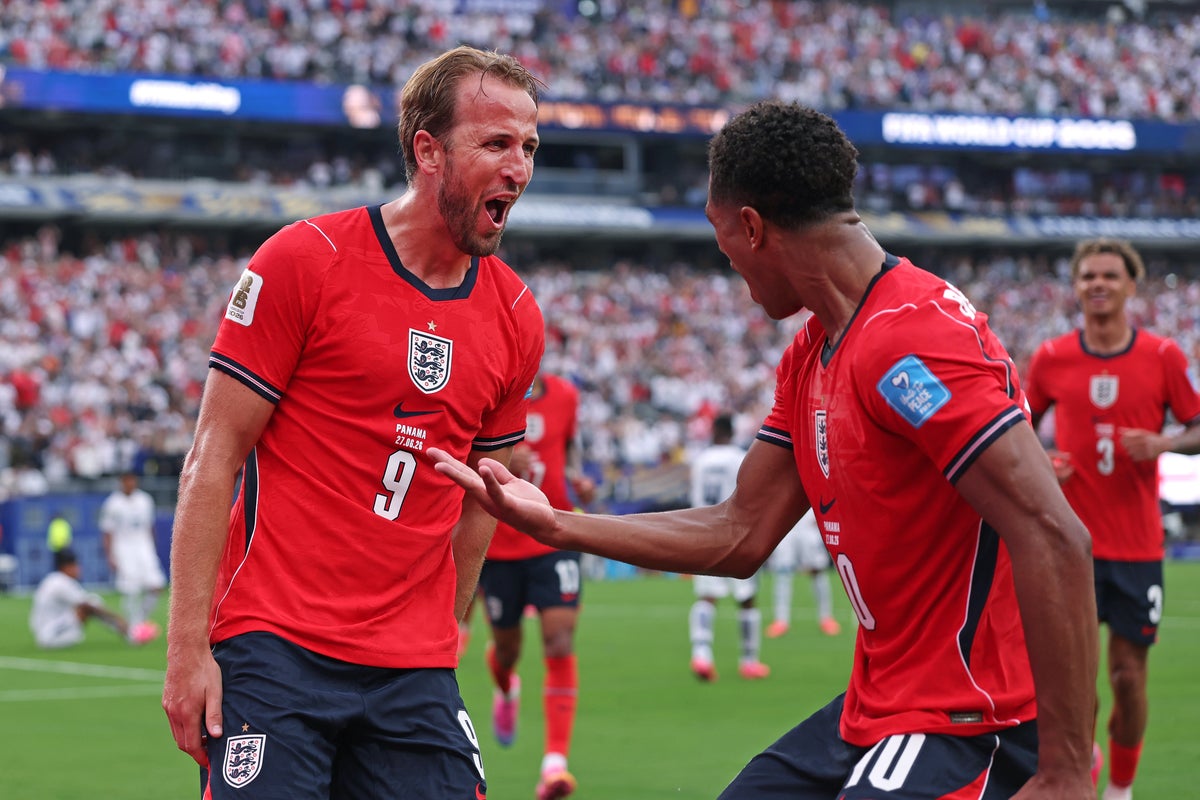
There’s also the way they toiled to confirm it. Thomas Tuchel’s side were again dependent on Jude Bellingham, a set-piece and a record-breaking Harry Kane. The captain became England’s record World Cup goalscorer, with an 11th that ultimately sealed a 2-0 win over Panama.
It isn’t so much football that people in the pub enjoy any more, mind, but one coming out of the more prosaic parts of coaching seminars – at least elevated by Bellingham’s ingenuity.
And if one increasing worry is how England have suddenly stopped creating space around the opposition area, they are offering up a lot around their own.
It gives Tuchel two huge issues to solve, now this World Cup finally gets serious. A last-32 tie against either Senegal or Democratic Republic of the Congo in Atlanta now awaits.
They’re going to have to do a lot of tactical work in between. This is suddenly a team that looks like it has gaps in many areas, especially defence and – for now – midfield. England missed Declan Rice against a resolute Panama. The links weren’t there, with Kane again marked out of the game until the first goal, and even Elliot Anderson more exposed.
Panama were successfully finding openings at one end, and staying solid at the other.
This is of course why Tuchel felt the need to rest Rice in the first place: because they’re going to badly need him. He’s arguably less replaceable than Kane, and even now Reece James.
There is nevertheless one other theory about that approach, and even the concerns that came from this win. Tuchel’s idea increasingly looks like one built for the transitions that will be more apparent in games against the elite sides.
Hence how Kane is so central, and not just as a goalscorer, but also the way his raking balls are intended to release pace out wide. England may enjoy much more of that against sides who seek to control a match.
That might totally stand to reason given the one thing that is now always said is that the real test is how England do against the first proper team they play, but the toughest challenge for now might be getting that far.
Tuchel’s side have now toiled in two matches where they were expected to be in full command. And, yes, they had most of the control but couldn’t really embellish it or take it on with any combinations.
That was where the worry was. If Tuchel has talked enthusiastically about building an intense attack that gets people excited with forwards coming from everywhere, there was none of that here. By contrast, so many attacks broke down with the wrong pass or a bad option.
As early as the 15th second, Tuchel was berating his captain for arching one of those passes straight out of play.
Bukayo Saka and Marcus Rashford, back in the starting line-up, couldn’t properly link up with those around them. Rashford at least offered England the urgency they needed, and it was his runs that at least increased the intensity before Bellingham’s game-breaking goal.
Before that, Bellingham himself had looked frustrated, and Morgan Rogers – in for Rice but playing as the 10 – actually couldn’t get into the game.
Ezri Konsa was again exposed.
A central issue, so to speak, might be the one at right-back. With Jarell Quansah in for Reece James, over Djed Spence, England just didn’t have any mobility. They were so flat.
So, they sought to curl in a set piece. On 62 minutes, Saka hit one of his corners, and there was Bellingham to finish. The surprise was that it wasn’t a header. Maybe it couldn’t be against this Panama defence.
Because, after a long period where Thomas Christiansen’s side looked so physically imposing at the back – and much stronger than England – they were suddenly undercut. There was almost an incongruity to how Bellingham deftly turned the ball in on the spin, after so many battles.
It was the little touch of quality that was required. With Panama’s gameplan rumbled, Kane headed in Bellingham’s own cross moments later. Some momentum was back, even if it was never close to the feeling of that 15 minutes against Croatia.
Whether England can regain it may actually depend on the opposition they face.
Maybe that’s why the more leaden nature of these performances isn’t a worry.
Maybe that’s what it’s all building to.
But that’s if they get that far. Because, before then – and a prospective quarter-final against Brazil in Miami – it’s going to be more of this.
England are suddenly built for games that they have to really battle to actually get to.
They stay en route, but it all looks more difficult to navigate than had been anticipated.