

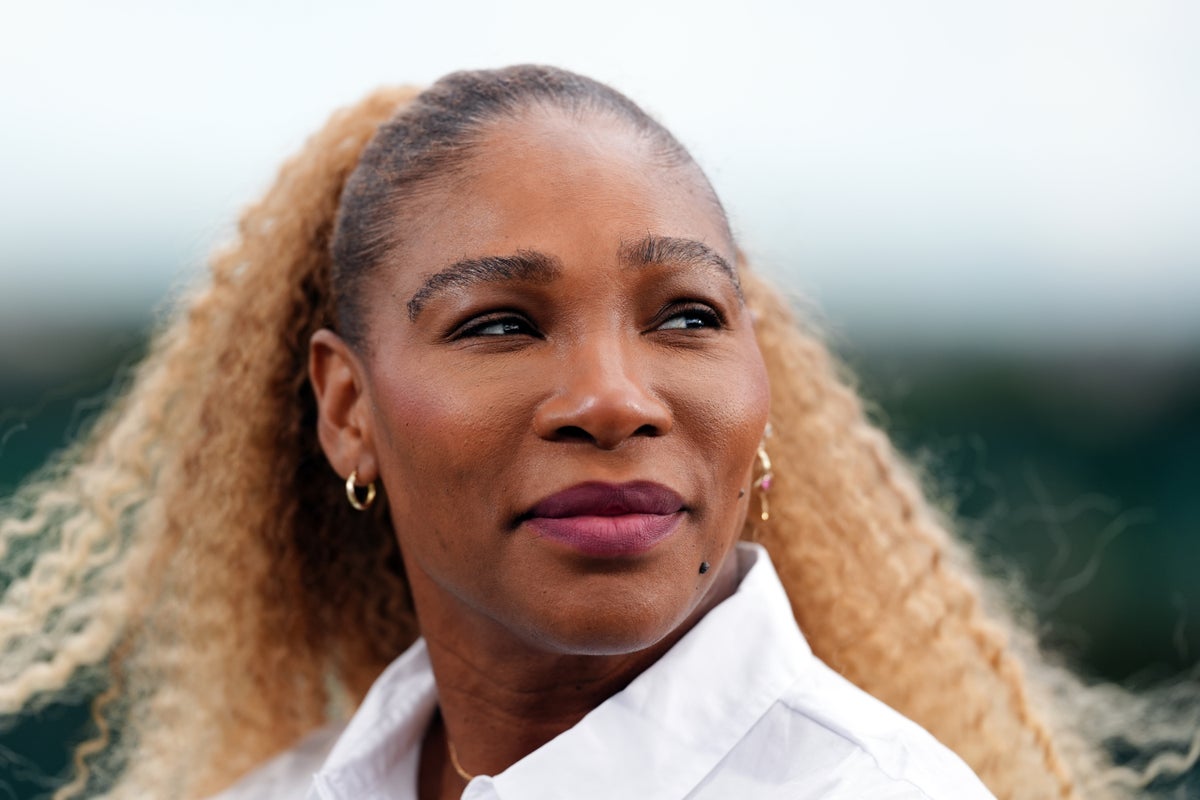
Serena Williams hit out at the “grueling”, “unprofessional” and “unreasonable” rules around anti-doping testing as the 23-time grand slam champion prepares to make her comeback at Wimbledon after four years away from tennis.
Williams, 44, will play her first singles match since the 2022 US Open when she plays Australia’s Maya Joint on Centre Court on Tuesday after accepting a Wimbledon wildcard, having announced a spectacular comeback to the sport earlier this month.
Rumours of Williams’ return first surfaced last October when it was confirmed that the seven-time Wimbledon champion had re-entered the International Tennis Integrity Agency [ITIA]’s anti-doping testing pool.
Even though Williams only stepped back onto court at the Wimbledon warm-up event at Queen’s in June, the American has been subject to random checks at her home and daily whereabouts notices since last August under the testing pool protocols.
Last week, former Wimbledon champion Marketa Vondrousova was handed a four-year ban for refusing a test after an anti-doping agent visited her home outside of the one-hour window she had provided.
The ITIA’s CEO Karen Moorhouse said unpredictable testing “is an essential tool to protect clean sport”. She added: “This case is an important reminder that players can be tested at any time, in any place, and that refusal comes with significant risk.”
Williams, who has two children, said the anti-doping protocols were a “big reason” why she deliberated against returning to the sport and claimed they have become more arduous in her four years away.
“It’s gruelling,” she said. “They changed the rules now. I didn’t know some of the rules. So apparently if you miss a test outside of your window, it still counts as missed. I’m like, I guess I can’t go pick up my kids.
“It’s unprofessional. I hate it. I think it’s necessary, but if I want to go places outside of my window, I should be able to go without having it count as a missed test.
“I mean, my life is busy. I run a company, I travel the world. I have children. It’s like I could be in so many different cities so many different times.”
Williams said she had to get used to the routine of reporting her whereabouts once a day. “Obviously I don’t mind because I love and I always have been very clear about what I do.
“I guess now for 24 hours where I’m going to be is just different – at least for me. I don’t know if that works for everyone else.”
Following Williams’ comments, the ITIA issued a response: “It is worth clarifying the whereabouts rules. If a tester is unable to reach a player during their allocated hour, then it may well be a missed test, and three failures could lead to a charge. If a tester is unable to reach a player outside of their allocated hour, it is not considered a strike.
“There have been no changes to the whereabouts rules in the last few years. We understand the system can seem challenging, but it is there to protect players, not to trip them up. If players are unsure or have questions, we would welcome a conversation with them directly or through their agents.”
Vondrousova, who won Wimbledon in 2023, refused an out-of-competition doping test in December 2025, saying she had “reached a breaking point after months of physical and mental stress” and that the incident resulted in an acute stress reaction.
She said the visit from a doping control officer, which occurred at 8.15pm at her home, was a “serious intrusion” into her privacy.
Vondrousova also explained during the hearing that stress and poor mental health affected her decision-making, as well as concerns for her safety, and said that the tester failed to properly identify themselves.
An independent tribunal convened by the ITIA said the evidence Vondrousova provided offered “no compelling justification” for her refusal of the test, and banned her from the sport until June 2030.