
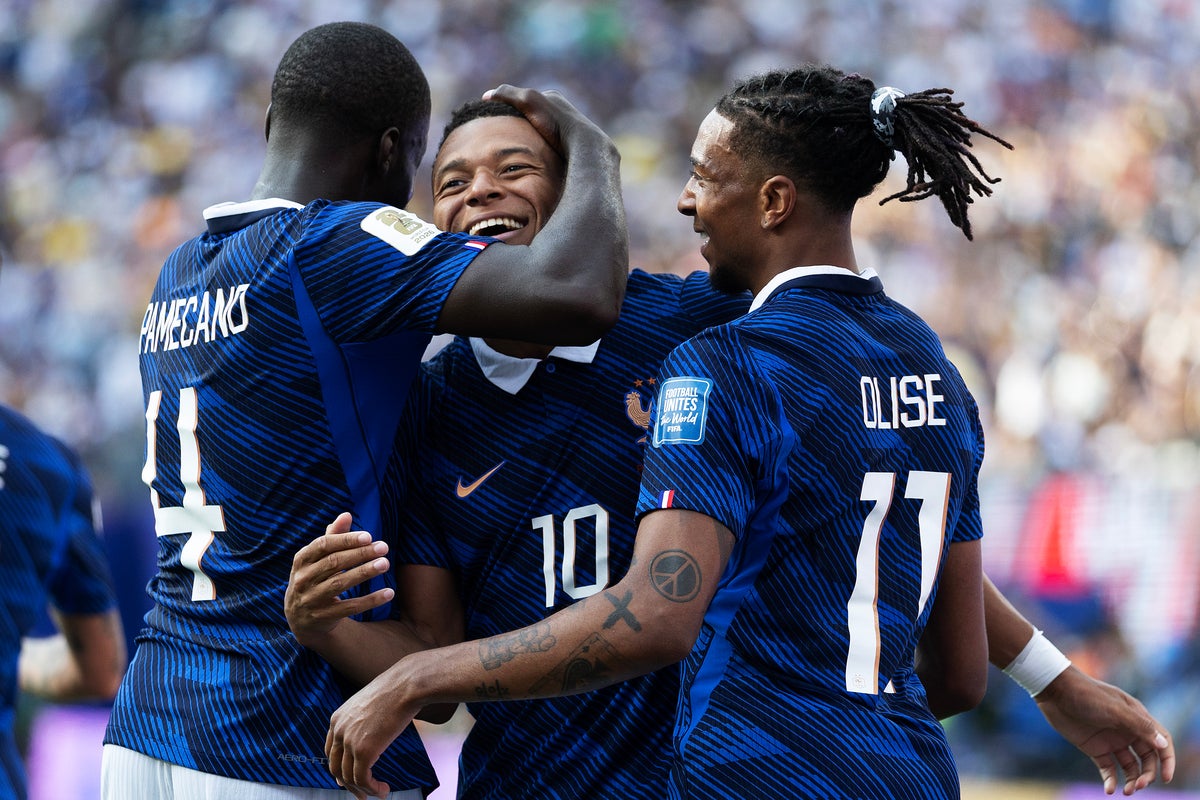
On the Boston training ground that has formed the studio for France’s “art”, to quote one insider, Kylian Mbappe and his orchestra have only really had one instruction. That is to “express themselves”, to do what “comes with instinct”.
If this sounds unusually romantic for a coach as pragmatic as Didier Deschamps, he offered up even more evocative words for the media, in speaking about that illustrious trio of Mbappe, Michael Olise and Ousmane Dembele.
“They speak the same football.”
Typically with Deschamps, mind, there is more edge to that than just nice phrasing.
And it’s partly why France have already had more to them than almost any other team at this World Cup, as well as most in modern history.
One coach at the tournament is adamant they are “one of the best attacking teams ever”.
And after 13 goals in four games, largely delivered by three attackers that are among the best five in the world, is it really that exaggerated?
France have not just been the model of a team who immediately look like they’re going to win the World Cup, such as Germany 2014, Brazil 1994 or West Germany 1990.
They’ve also been that rare “team of the tournament”, the gloriously adventurous side that elevate everything and capture the imagination.
Brazil 1994 and Germany 1990 didn’t go to these levels.
This has been more like the Netherlands 1974, Brazil 1982 or… fittingly, given the country’s own traditional football spirit, France 1982.
Such sides often have an air of tortured artists, as if their very creativity was always going to condemn them to eternal frustration.
There’s little of that with this France, not least because the very manager and captain have won it as recently as 2018.
Through that, speaking of exaggeration, we may end up talking about something akin to Brazil 1970.
There is still a very long way to go, of course, but all of this shows how France have also come a long way under Deschamps.
It was in the build-up to this very tournament that doubt was expressed over whether the manager’s era already went stale two years ago, over whether he would just suppress this attack.
Even this team, which represents such a joyous lift from Euro 2024, raises the question over whether Deschamps has actually wasted the talent of the last eight years.
Respectable as the 2018 victory was, a sense persisted of a team that dourly played within their limits rather than expanding.
The “water carrier”, as he was known as a player, didn’t fashion a team that flowed.
In the same way that was all down to Deschamps’s own instincts, though, this new trust in the attackers’ instincts may be just as much down to him.
He is still being pragmatic, but it now happens to work at the other end of the pitch.
Deschamps has the best attackers in the world… so why not? It’s logical.
Some who know the manager say there might still be a sense of rolling the dice for his last tournament, that “a winner” like him is conscious he should have won more.
So, the last ever Deschamps team now looks like the ultimate anti-Deschamps team.
The asymmetric 4-2-3-1 of 2018, that had such clearly defined roles, is now gone. In its place is fluidity and movement.
And yet, in the same way that still represents a form of pragmatism, some Deschamps principles persist.
Having brought Monaco to the same 2004 Champions League final with which Jose Mourinho made his name at Porto, Deschamps has similar ideas about attack: that it doesn’t need the rigorous structure of defence. The emphasis on a mid block just greatly tempered that freedom.
And after years when Pep Guardiola’s positional game dictated that this was obsolete, certainly in the club game, things might have come full circle.
That attacking freedom now feels revolutionary in a world where everything in football is so programmed.
There is nevertheless more “idea” to this than just freedom.
The intention, in the words of one insider, is that your attackers enjoy this liberty so much that the chemistry they develop becomes insatiable; that they start to deeply understand each other.
That they “speak the same football”, in other words.
Hence Olise is able to open entire defences – and games – with those insightful short passes.
Players like Dembele, Desire Doue and Bradley Barcola are meanwhile described as being “released” from Luis Enrique’s rotational dogma, great as it’s been for them. Mbappe gets a break from the “intense hatred” at Real Madrid, in an approach that better suits his qualities. It may be better for his mood, too. The stats show Mbappe is pressing more than double the amount he did for Madrid last season. He’s all in. Olise is meanwhile seen as “playing like he’s getting to fulfil his destiny”.
This freshness, from comparatively less taxing club seasons, especially at Paris Saint-Germain, only further sweeps all this along. Players are left to just link up in such luscious fashion.
Some will be familiar with the phrase for this in coaching circles: “relationism”.
Opposition sides find it difficult to prepare against because there is no pattern.
Declan Rice even inadvertently touched on this when talking about facing low blocks, something that France have had no issue with.
“It’s hard because you have a structure the manager wants you to play in. And sometimes you have to do something for the good of the team, even though you feel like you don’t want to do it because you feel a bit stuck.”
There’s none of that with France, especially with Olise’s fluidity. He imposes some kind of framing, albeit from his own individual interpretation, in the way that Luke Modric did for Madrid’s midfield.
France’s own midfield admittedly looks much thinner, but the attackers make it work – for now.
Adrien Rabiot and Aurelien Tchouameni offer the engine required.
That can occasionally mean France are exposed, and opposition coaches do believe that their defence is more susceptible than the scorelines show.
Set-pieces are a particular vulnerability. Jules Kounde – one of the last remnants of the previous Deschamps teams in terms of preferring three centre-halves for the back four – has been superb at the back post.
It couldn’t be Deschamps, however, without offering some caution.
“Feel free to find the issues,” he told journalists after the win over Sweden. “Not everything should be rose-tinted, we shouldn’t get carried away.”
And so, if France look much better primed to sweep away teams like Paraguay, Spain may be better suited to the higher-level games.
Deschamps’s two-man midfield could find real issues against Spain’s three, if they get that far. France do ultimately lack that controller; an Olise that plays further back.
And, if they get that far, there’s the possible challenge of Argentina. That is seen as “psychologically huge”, given everything that has happened from the 2022 final.
Right now, though, France seem primed to surpass that.
They can surpass many sides in history. As Deschamps himself might say, though, talk – or “speak” – is cheap.
This is still about results, but no side has end product like this.