

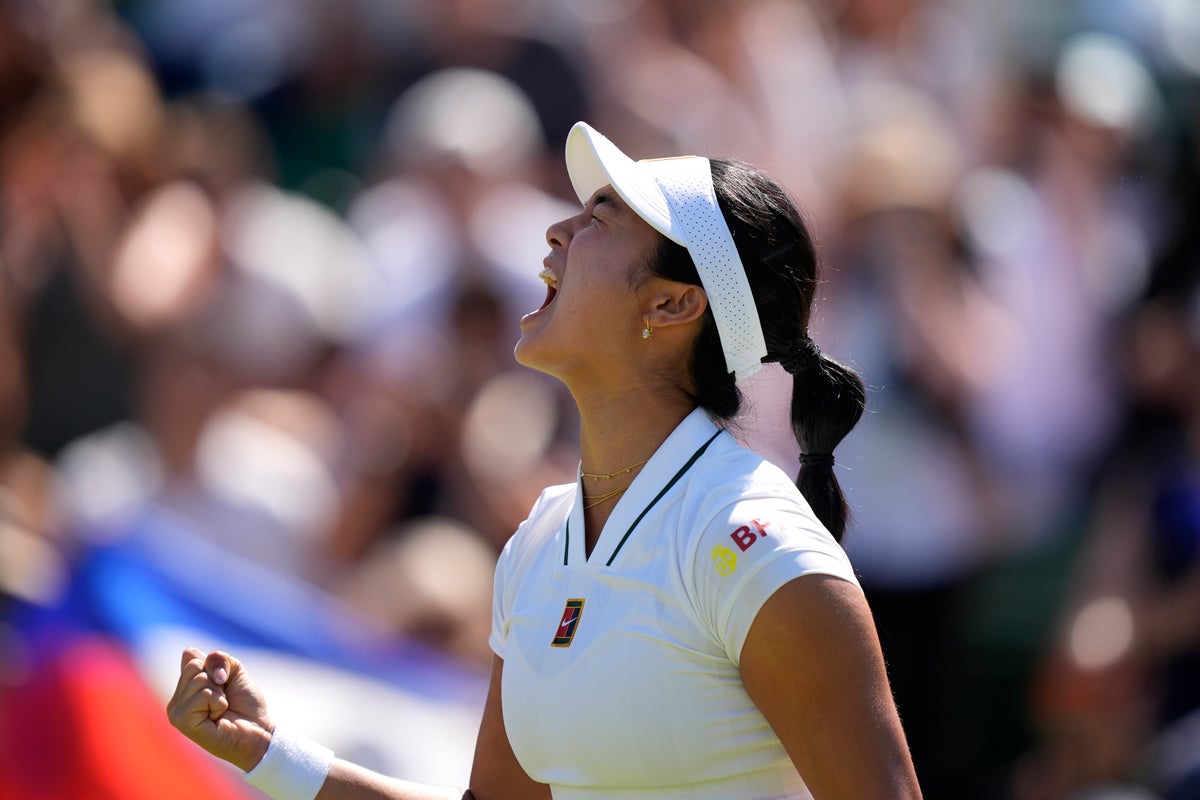
On the back of Alexandra Eala’s white visor at Wimbledon is a message, written in the language of her native Philippines. It reads, “Kapag lumago, hindi na hihinto”, which roughly translates to, “Once it grows, it cannot be stopped”.
On Saturday, the 21-year-old will take the next step of her journey when she steps out, onto what is likely to be Centre Court, to face defending champion Iga Swiatek in the third round of Wimbledon. It feels as if Eala breaks new ground for her country wherever she goes, and at Wimbledon, where she is the first Filipino player to reach the third round of a grand slam, history is once again being written in real time. The Philippines is a country of roughly 110 million people – the archipelago in south-east Asia is the 12th most populated country in the world – but before Eala its impact on tennis had been marginal, if it even had one at all.
“It sounds super impactful,” Eala said. “It’s an amazing thing for me to be able to do that for my country, but I guess it’s also very emotional every time I’m able to pass a new step or break new ground, just because it’s also personal goals and personal achievements. It’s things that I have been working really hard for. It’s things that my team has been working really hard for. I really appreciate that I’m able to share this with the nation, but I think first and foremost it makes me super proud because of the work that I’ve put in.”
Thanks to Eala, the Philippines has become a tennis nation overnight. Like Brazil, as seen with former world No 1 and two-time French Open champion Gustavo Kuerten, and now with rising star Joao Fonseca, her people have wanted to join in with her journey ever since the fresh bud of her talent suddenly emerged in March 2025. Wimbledon also brings her full circle against the opponent where her big breakthrough began; as a 19-year-old wildcard at the Miami Open last season, ranked 140th in the world, Eala reached the semi-finals and defeated Swiatek, the world No 4. It was a monumental upset that announced her arrival.
When Eala walks out on Centre Court to face Swiatek again in the third round of Wimbledon, many of the supporters in the crowd proudly waving the flag of her native Philippines will have spent the whole night waiting. Already a superstar back home, Eala inspires a devoted following from the Filipino community wherever she plays, which has occasionally caused tournament directors a bit of a headache. At the Australian Open earlier this season, ridiculously long queues stretched through the grounds as her fans waited patiently to pack onto the tiny Court 6. There were not nearly enough seats to meet the demand.
The night before each of her matches so far at the All England Club, Eala’s fans can be seen arriving at Wimbledon Park and joining the official Queue, settling in for the night. She entered Wimbledon as the 29th seed – another milestone, as the first Filipino player to be seeded for a grand slam – while her 6-1 6-2 first-round victory over Renata Zarazua made Eala the first player from the Philippines to win a main draw match at the Championships. In the second round, she battled from behind to beat Maya Joint, the conqueror of Serena Williams on Tuesday. In the end, it was comfortable: 3-6 6-2 6-0.
It is fitting that her first third round at a grand slam would come on grass, where her tricky left-handed game and devious slice become even more dangerous as the ball skids flat and low. Eala cannot always overpower her opponents, but she can disrupt them, looking to rob them of rhythm and pace. Her wins on grass this season include victories against world No 2 Elena Rybakina, a former Wimbledon champion, world No 8 Elina Svitolina, a former Wimbledon semi-finalist, and Donna Vekic, another former Wimbledon semi-finalist who won the title at Queen’s the week before.
Swiatek, meanwhile, returned to Wimbledon as defending champion yet still sounded pessimistic about her chances. “Even though I won, I still feel like I have stuff to figure out,” she said. “It’s not going to be smooth because of last year.” There were stressful moments in her round-one win against Taylor Townsend, less so in the second round against Karolina Pliskova, where Swiatek was able to get what she wanted and take charge, playing the match on her terms. The world No 3 expected Eala to be more of a challenge. “She has a tricky game,” Swiatek said. “I can assume that on grass it’s even more tricky because of the surface.”
Even though she is through to the third round of a grand slam for the first time, playing the defending champion on Centre Court will not be an entirely new experience for Eala. It was just last year that she faced defending Wimbledon champion Barbora Krejcikova in the opening women’s singles match on Centre Court, winning the first set but eventually going down in three on what was her Wimbledon debut. She returns with another 12 months of experience on tour under her belt, and the results to back it up.
Eala will carry the essence of the sampaguita, the delicate white species of jasmine that has been the national flower of the Philippines since 1934 and represents humility and hope. The message of “once it grows, it cannot be stopped” also applies to her supporters, who feel inspired to follow her. “This is my journey, I’m happy to be able to share it with everyone who wants to take part,” Eala said. “For me to be able to represent the Philippines in Wimbledon and in the biggest stages in the world, it means so much.”