

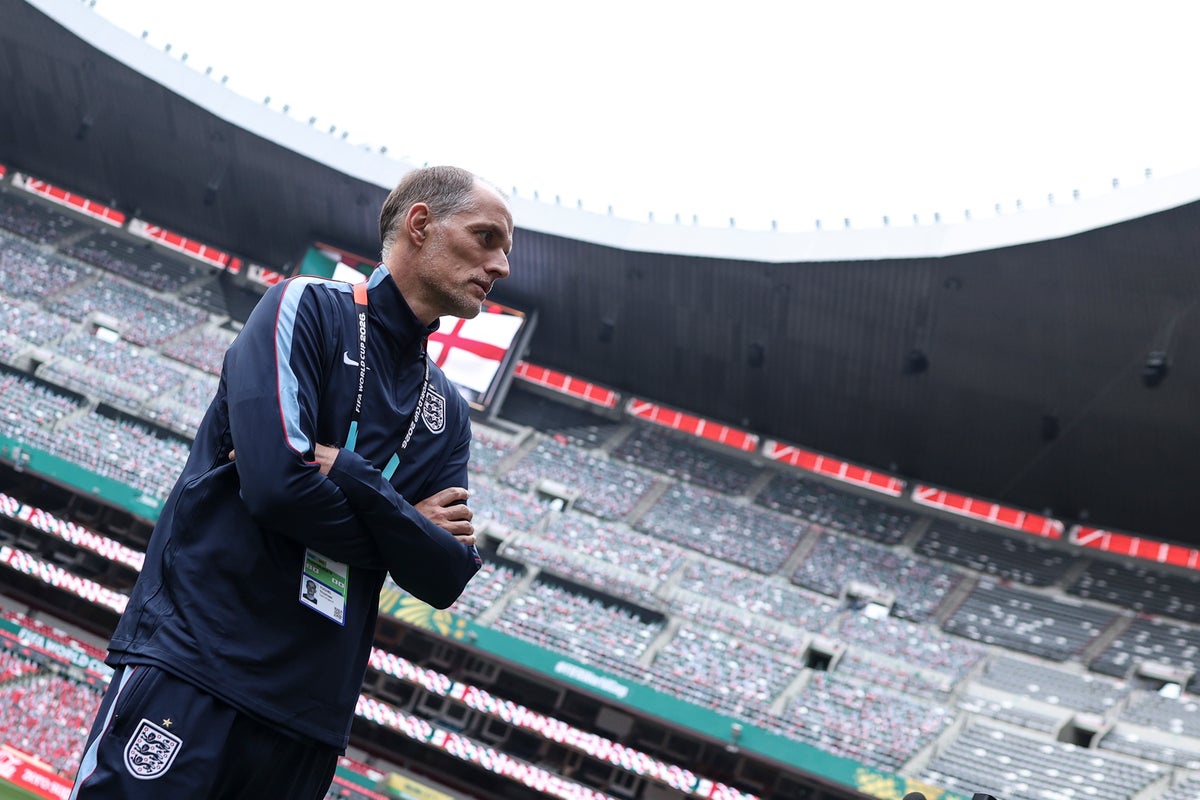
No matter the line of questioning or unorthodox phraseology in use, Thomas Tuchel treats every conversation the same way. Asked about the altitude in Mexico City’s Azteca Stadium, the German openly admitted he himself had a “headache” on Saturday morning. Asked whether the rumours that the England team would use viagra to combat altitude sickness were accurate, he laughed and stated: “That is not true.” Asked about 1986 and Maradona’s “Hand of God” at the same stadium, he insisted his players were “not out for revenge.”
Every topic, no matter the language barrier or brazen attempt to lure a quote of intrigue, is treated with the same token of respect and detail from the 52-year-old coach. And in front of 100 or so journalists at his pre-match press conference before the biggest match of his Three Lions tenure so far, all the German wants in return is respect the other way. On the eve of the grandest occasion this stadium has seen in 40 years, he had a message to Mexican supporters attending the Azteca cauldron on Sunday.
“What I’ve experienced until now [from Mexico fans] was very respectful, emotional and supportive,” he said. “We are respectful of everyone and then we expect to be treated with respect.”
Clearly, for Tuchel, there is a figurative line not to be crossed on Sunday. Passion, fervour and noise? Absolutely. Hostility, vulgarity and violence? No, thank you.
“It will be emotional and full of support for the home nation,” he added. “But I don’t expect any hostility. Everyone was very respectful so far. I don’t expect a hostile environment. A stadium like this… not a lot of stadiums can create an atmosphere for the home team. It can create momentum and belief in the home team. We expect that.”
That goes for any potential disturbances overnight at their hotel – as Mexico’s round of 32 opponents Ecuador experienced – based to the west of the city centre. “Fifa are aware of the situation, we have security around the hotel. It’s a 6pm kick-off, so if we don’t have sleep, we have time to get some hours in in the morning.
“I don’t want to talk about problems that don’t exist… if they come, we will accept them. It’s a demanding tournament in itself; the best way to approach it is to be relaxed.”
Tuchel’s constant stream of common sense coupled with his childlike effervescence is somewhat infectious. Earlier this week, he spoke about his memories of the 1986 World Cup as a 12-year-old growing up in the small Bavarian town of Krumbach. As a young boy, it was Azteca heartache as West Germany were defeated by Diego Maradona’s Argentina in the final. Now, he wants to be on the right side of the contest at the World Cup’s most iconic venue.
He provides such detail, clarity and prudence in all of his answers that you go away utterly convinced by his framing or narrative. And the question holds: if he’s this good in front of the cameras, how good is he behind closed doors?
In the opening game against Croatia, the curtain was somewhat drawn back. First, you had assistant Anthony Barry’s forthright opinions aired to the nation on ITV at half-time. Then, you had a second-half onslaught, probably the best half of football England have played for at least two years. And afterwards, you had adulation; whether it was Harry Kane, Declan Rice or Jude Bellingham, their overwhelming praise of Tuchel’s control of the dressing room at half-time spoke volumes.
Even Friday’s baffling kick-off saga left the squad unimpacted, conveniently flying on a plane from Kansas. “When you’re inside the bubble, it’s actually quite calm and focused,” Tuchel said. “This example shows you not to lose your head. It’s just not worth losing our heads. It’s not in our favour, we have the spirit and commitment and pure will in the team. That’s why I’m positive: we know what’s coming, the players will feel it, that’s the beauty of it. We’re focused completely on what is possible.”
Perhaps the most impressive string to Tuchel’s bow was his open fountain of knowledge about the Mexican team, their style and patterns of play. “They are a top-10 side – they’ve had some good results, not just in the World Cup but in March.
“They’re very flexible in their approach; they change their defensive formations in the match from high pressure to low pressure. When they attack, they attack with a lot of players in the middle of the pitch, a lot of rotations, never shy to play direct into (Raul) Jimenez. I think we are prepared, we try to exploit weaknesses, and we’re full of respect – we are fully aware that we need to put a strong performance together.
“Tomorrow, we will bring it together for a top performance.”
Of course, top-tier rhetoric does not always translate into top-tier results and performances. It’s been much discussed the myriad of factors which hand Mexico an advantage: altitude, fans, stadium. Also, they were just so impressive in that first-half against Ecuador. Walking around Mexico City these past two days, you sense the wave of unparalleled optimism radiating from one person to the next. A win could see two million people line the streets on Sunday night; 17,000 police officers will be deployed.
But, with all due respect to Mexico head coach Javier Aguirre (in the role for a third time), Tuchel is a potential difference-maker and game-changer from the technical area. In a contest which could well come down to fine margins, England’s saviour could well be the cool-headedness and practicality of the Three Lions head coach.
And he’s engrossed in the enormity of the task at hand. Someone unbowed by the pressure of the event. As he said himself: “This game makes me feel so alive.”