

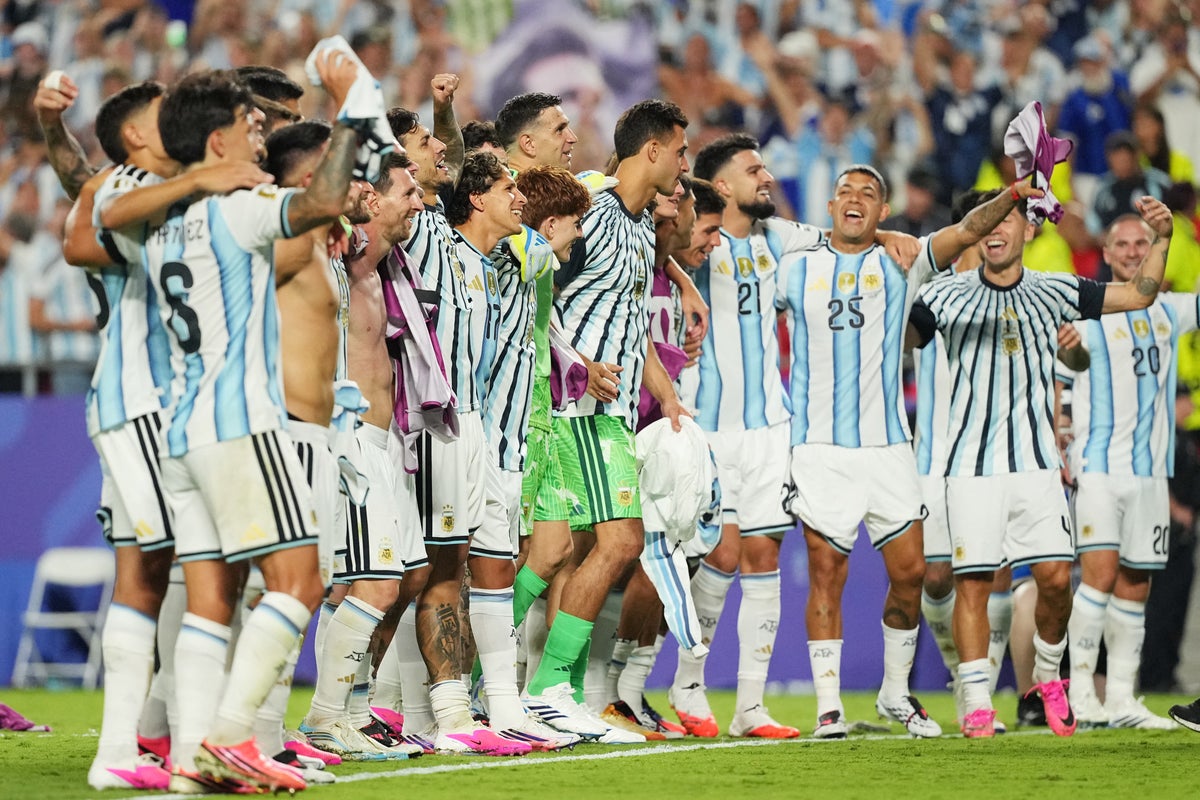
“When you reach a semi-final you need to suffer,” said Lionel Scaloni. Although did Argentina need to suffer quite so much? Taken to extra-time by a depleted Switzerland side, just as they had been by the minnows of Cape Verde, and requiring a record-breaking comeback to see off Egypt, the defending champions’ route through the knockout stages has seemed based on suffering.
But after Switzerland were beaten in Kansas City, Scaloni kept returning to a reason why it was a struggle, one that could have pertinence for their last-four date with England in Atlanta: physicality. “Physically they are a very strong squad,” he said. “It was very difficult for us to win the duels. Switzerland are very good on a physical level.”
And perhaps Argentina are not. They have the staying power and spirit to conjure late goals – in their last three games they have scored in the 79th, 83rd, 92nd, 92nd (again), 111th, 112th and 121st minutes – but there are different types of physicality. Their most celebrated player is famously unphysical: a year from his forties, spending much of the match walking, though technically brilliant.
But his teammates may not compensate with running power. Fifa’s statistics show Argentina only 10th for sprints made, behind three teams who have played a game fewer. More remarkably, they are 48th out of 48 for average speed at which their players have moved in this tournament. Lionel Messi may be dragging them down in one respect.
Among players, he is 580th for average speed; even Cristiano Ronaldo is 501st, and some of those below him are goalkeepers or centre-backs whose job description involves less movement. But this is no indictment of Messi; the instructive element is that others are not compensating with lung-busting running.
Jude Bellingham, who they will face on Wednesday, ranks second for most sprints in the World Cup. The first Argentinian, Enzo Fernandez, is tied for 19th place. Some 20 players figure above any of Scaloni’s side in Fifa’s charts for what they term high-speed running.
The two players who have covered the most distance in the tournament are the Swiss central midfielders, Remo Freuler and Granit Xhaka. Alexis Mac Allister is the only Argentinian in the top 20.
All of which could explain why Argentina laboured to turn the most obvious physical advantage – having an extra player after Breel Embolo’s red card – into greater numbers on the scoresheet. It is also worth noting that Switzerland had played 120 minutes against Colombia in the final game of the round of 16. They were down to 10 men against Argentina for an hour, stoppage time included. They only buckled in the last 10 minutes. Argentina face other European opposition next, in England, with Thomas Tuchel wanting to see Premier League pace and power from his side.
And Argentina may be susceptible to it. Both Cape Verde and Egypt were a threat on the counterattack against them; when Argentina open a game up, they risk being isolated one against one in races they may lose.
The introduction of Leandro Paredes to the side seemed designed to give a shielding presence against quick breaks. It did not entirely work against Egypt, but it may also have been a recognition that, even with the trio of Mac Allister, Fernandez and Rodrigo de Paul, Argentina had insufficient solidity in midfield.
But the policy of getting players around Messi leaves space elsewhere, primarily on the sides. Cape Verde’s first goal came from their right side, their second from their left. A feature both of Dan Ndoye’s equaliser for Switzerland and of Egypt’s disallowed second goal, and then the one that stood, was that they outflanked Argentina’s concentration of players in central areas; their full-backs can lack protection which, given the width Tuchel wants his wingers to exhibit, could offer England optimism. So, given the speed he wants, could be Argentina’s issues with quick breaks.
England’s problem may be that they are not at peak physical condition themselves. Declan Rice has been weakened by first a hamstring problem and then illness. Bukayo Saka and Reece James have had achilles and hamstring problems, respectively. John Stones’ body may be a permanent cause of concern. Like Argentina, England had to play 120 minutes on Saturday.
It is shaping up to be a semi-final between teams who have creaked but not crumbled, finding a way to find a way. Argentina have the medals to prove they can last course and distance. If they arguably have too few miles in their legs in this World Cup, they may have too many in total. Scaloni’s side against Switzerland was the oldest team in a World Cup quarter-final since Brazil in 1962; who, it may be remembered, went on to retain the trophy.
Maybe Argentina will follow suit, proving their race is not yet run; or walked, in Messi’s case. But even as they have struggled against Cape Verde, Egypt and Switzerland, they have got better at one physical aspect of the game. A team who scored no headers in Qatar have three already. Argentina, with their mental strength, may believe the secret to success lies in the head.