

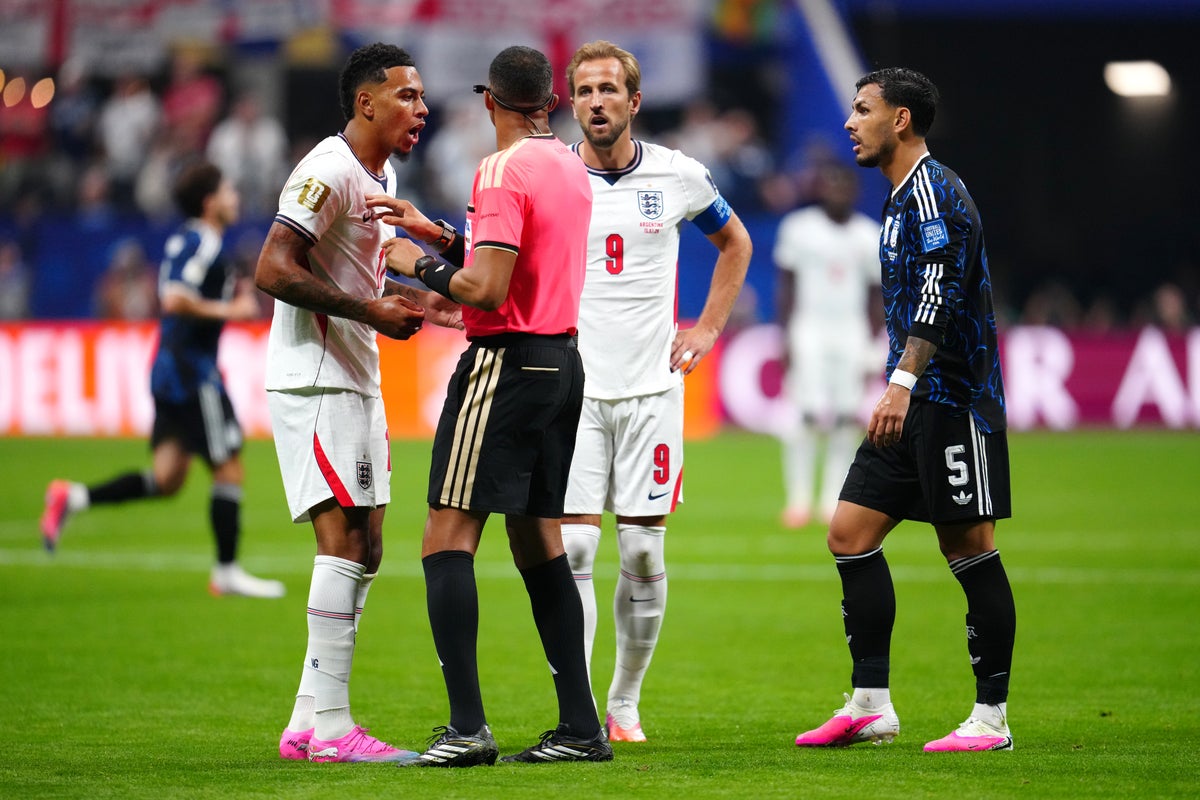
World Cup officials are strictly enforcing a new rule, introduced before the tournament, which mandates an immediate red card for players covering their mouths during verbal confrontations with opponents.
During England’s World Cup semi-final with Argentina, midfielder Leandro Paredes appeared to try and get Harry Kane sent off for this action shortly before half time.
Paredes complained to referee Ismail Elfath after the England captain briefly covered his mouth while talking to the official.
Kane, however, was not involved in a confrontation with an opponent.
He appeared confused as Paredes approached the referee and complained that the striker had been covering his mouth.
Former England goalkeeper and BBC pundit Joe Hart labelled Paredes as “pathetic” for trying to get Kane sent off.
Has the directive been seen at the World Cup?
The directive has already been used twice at the tournament, when both Piero Hincapié of Ecuador and Paraguay’s Miguel Almiron were sent off for covering their mouths during confrontations.
Paraguay midfielder Almirón was the first player to be punished under the new rule when he was sent off in a group match against Turkey for covering his mouth during a confrontation with defender Mert Mulder.
Paraguay won 1-0, but Almiron missed Paraguay’s final group game against Australia.
FIFA said that decision was not subject to appeal.
This directive was also highlighed when Ecuador defender Piero Hincapié was sent off in second-half stoppage time during his team’s 2-0 loss to Mexico in the round of 32.
The red card, following an exchange with Mexico forward Santi Giménez, did not impact the match’s 2-0 outcome, but underscored the rule’s strict enforcement.
Why did FIFA establish the new rule?
A new FIFA rule, dubbed the “Prestianni Law,” will allow for red cards to prevent players from hiding abusive, discriminatory, or offensive language, following a recent international soccer controversy.
FIFA president Gianni Infantino championed the change after Benfica winger Gianluca Prestianni was accused of attempting to hide racially charged verbal insults toward Real Madrid forward Vinícius Júnior during a Champions League match in February. Vinícius alleged Prestianni covered his mouth with his jersey.
The International Football Association Board (IFAB) unanimously approved the guideline. It allows for red card penalties if players cover their mouths while verbally confronting an opponent. Though not mandatory in the Laws of the Game, the rule grants tournament organizers, like FIFA, discretion to implement it. IFAB, including officials from FIFA and the four British soccer federations, ratified the proposal at a special meeting.
What does it mean when a player receives a red card at the World Cup?
If a player is shown a red card by an official, he is ejected from the match and must serve a one-game suspension in the following match.
The team is forced to play the remainder of the match with 10 players — putting them at a huge disadvantage — but is allowed to start the following match at full strength with 11 players, just not the suspended player.