

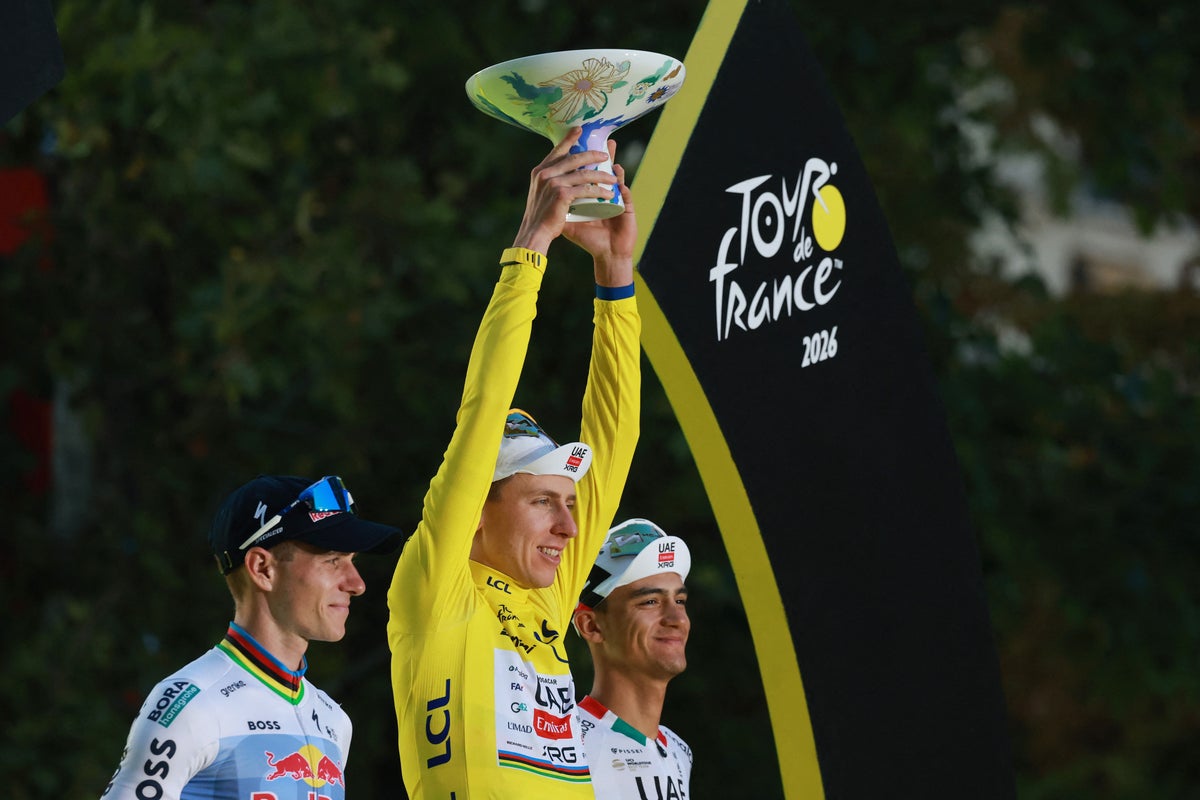
Few things in life are certain beyond death, taxes, and Tadej Pogacar winning the Tour de France. This year’s Grande Boucle went almost entirely as expected, offering few real surprises or diversions from the status quo, as the marauding Slovenian won another five stages en route to his record-equalling fifth title.
His place in the pantheon of greats had already been cemented and there are few superlatives left to describe his grip on the sport. He is now equal with cycling legends in the form of Eddy Merckx, Jacques Anquetil, Bernard Hinault and Miguel Indurain on five wins; his 26 stage wins leave him nine off the record of Mark Cavendish, who will be wishing he’d postponed retirement by another year or two.
There could have been more had Pogacar not opted to babysit young teammate Isaac del Toro to a stage win, third place on the podium, and the best young rider’s jersey too. Pogacar is able to win at will but sometimes seems happier in the role of world’s most powerful domestique; perhaps the only thing holding him back from an unprecedented sixth title is whether he can muster the enthusiasm for it. At 27, he is younger than all of his fellow five-time winners were and will be in his prime for a while yet.
But while the Pogacar era looks set to continue for some time, the post-Pogacar era already looks to be one to savour. Those left cold by the two-time world champion’s iron grip on the sport can set a reminder to tune in in a couple of seasons’ time, or perhaps as early as this autumn’s Vuelta, should Pogacar skip it – as expected – to target a third rainbow jersey.
Because while Pogacar has no real rivals, the rung of grand tour racers below him is in rude health. Much had been made before this Tour of the rapid rise of French 19-year-old Paul Seixas, who won European bronze behind Pogacar and Remco Evenepoel in an attritional race last year and continued his rapid progress this season, coming second to the Slovenian at Strade Bianche and Liege-Bastogne-Liege and winning a WorldTour stage race at the Tour of the Basque Country.
That hype appears justified after he finished fourth in his debut Grand Tour, a rather Pogacar-like result (he came third at the Vuelta a Espana in his first three-week race and was then sent straight to the Tour, after which, the rest is history). Seixas faded in the final week having been just 20 seconds off the podium after stage 16’s individual time trial, but the maturity and composure with which he rode was remarkable. France have had many Grand Tour hopefuls who have never fulfilled that early promise but the Lyonnais teenager looks to have both the climbing pedigree and the racing nous to deliver on it in years to come.
He also looks to be at the start of a fascinating rivalry with del Toro, the 22-year-old Mexican who already has podium places at the Giro d’Italia and Tour to his name. While he remains at UAE Team Emirates-XRG he will only ever be a superdomestique to Pogacar, but on the basis of those two podiums he should be the squad’s leader at any grand tour the Slovenian misses. He was unable to win the mountainous stage 15, towed up the same Plateau de Solaison climb by Pogacar which he mastered solo at the recent Tour Auvergne-Rhone-Alpes, where he won the overall, but was a clear third-best over the course of three weeks.
That stage was won by Evenepoel, who in many ways was the breakout star of this Tour despite already being a proven winner and former grand tour champion himself. The Belgian has had to endure plenty of criticism since his 2022 victory at the Vuelta a Espana, with many questioning his capability over three weeks and in the most gruelling mountain passes.
But over the last two seasons he has made himself leaner, a better climber, and a more durable rider, and that was evident here, as he recovered from a patchy first week to cement his best-of-the-rest status in the high mountains in the third; he was nearly three minutes clear of del Toro, despite the Mexican being shepherded along by Pogacar in the closing stages. Evenepoel’s teammate Florian Lipowitz, third at the Tour last year, is another consistent rider who had looked set to challenge for the podium before crashing out in the time trial.
Evenepoel’s much-debated transfer from Soudal-QuickStep to Red Bull-Bora-Hansgrohe, in the hopes of making him a real Tour de France challenger, has paid off. The 26-year-old’s outspokenness and strength of character is an additional boon for the sport amid an increasingly sanitised, media-trained peloton.
It would have been fascinating to see how Denmark’s Jonas Vingegaard would have handled the challengers in the Alpine final week, having looked far from secure in second place until that point and with Evenepoel in particular steadily improving in both form and confidence. His crash on an innocuous bend on stage 15, having been subjected to a 2am doping test mere hours before, robbed the Tour of an explosive battle for the remaining podium places.
Rumours abound of Vingegaard considering retirement after every demoralising defeat to Pogacar, and just like after last year’s Tour he has a point to prove, with a host of challengers rising up behind him. He responded last year by winning the Vuelta in dominant fashion and backed that up with victory at this year’s Giro.
But while Pogacar remains supreme, an immovable object at the top of the sport, the landscape around him is changing. Vingegaard is the best stage racer after him – but with the rise of Evenepoel, del Toro and Seixas, how long will that last? Cycling is on the cusp of a fascinating new era, and crucially, one which even those bored by Pogacar can look forward to.