

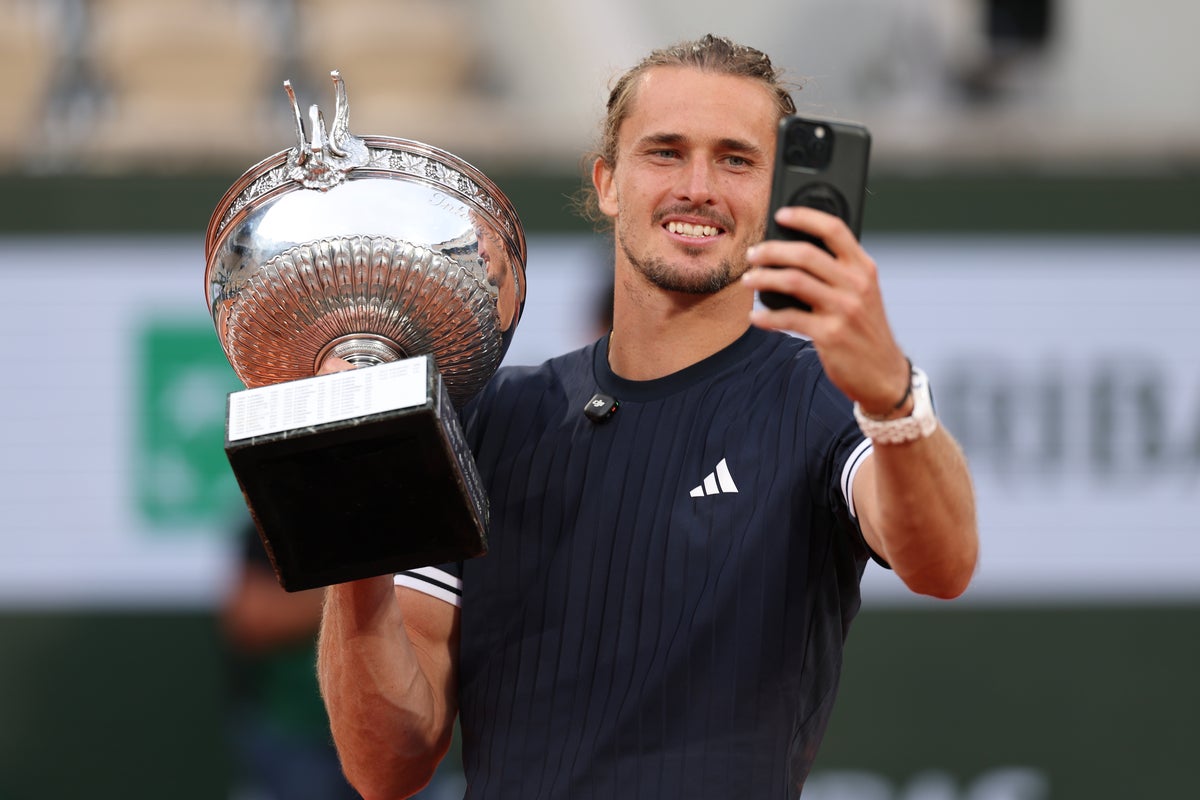
On the face of it this French Open was not particularly surprising: the trophies went to the second and eighth seeds, respectively a man long dubbed the best to have never won a slam and a teenage prodigy tipped to win a major since the age of 15.
While the final results were hardly seismic, the manner in which both players got there was, with nerves dominating the tournament as both draws, particularly the men’s, opened up. What had been expected to be a procession for Jannik Sinner turned into a complete free-for-all after the top seed melted in the first-week heat.
To say his defeat sent a shockwave through the draw would be an understatement. The question now is whether that shockwave will have fundamentally shifted the landscape of the sport, or whether Sinner will return, refreshed from an extra couple of weeks off, and re-assert his grip on tennis once again.
His sudden exit was a chance few could immediately capitalise on, which may lend some clues. The likes of two-time finalist Casper Ruud and permanent slam quarter-finalist Alex de Minaur completely imploded. Five of the eight third-round matches on the middle Saturday went to five sets, with many players desperately trying not to lose rather than playing to win. (That dynamic was equally present in a painfully nervy and error-strewn men’s final on Sunday.)
As Madison Keys noted drily, “I think we’ve seen in the men’s scores that they’re all really worried about who is going to be in the finals and not on the match today. I feel like their anxiety is slowly seeping into everyone’s lives.” Frances Tiafoe emphasised the significance and rarity of the opportunity: “You’re a part of history, however you want to look at it, whether you get it done or not.”
In Sinner’s absence the younger generation stepped up: Joao Fonseca, Rafael Jodar and Jakub Mensik, the latter a first-time grand slam semi-finalist, all acquitted themselves well before – in Fonseca’s case – running into an opponent at the absolute top of his game (Mensik) and in the case of the latter two, running out of steam.
But the experience of a deep run at a slam will be invaluable and the young trio’s fearlessness – Mensik is the oldest at 20 – puts them in the best possible position to capitalise should the sport’s established elite, like Sinner, show any further signs of weakness.
Sinner himself has rarely appeared to struggle under pressure except against Carlos Alcaraz, with heat, and five-setters, really his only vulnerabilities. He downplayed the impact of the conditions entirely and was as calm as ever in his assessment of the defeat – “It was a tough spot to be in. But, again, this is the sport. It was just me today, but it happens.”
His history suggests normal service will resume on the grass – he shrugged off the crushing French Open final loss to Alcaraz last year, when he spurned three championship points, and immediately went on to defeat the same opponent to win Wimbledon for the first time. So most likely, the burden will fall on the rest of the tour to convert the nerves and anticipation of this Roland Garros into sustained pressure on the Italian’s slender shoulders.
Ultimately it was Alexander Zverev, for so long tennis’ nearly man, who just about held his nerve to get through the draw and seal the title. It was hardly convincing, and the fifth set could have been significantly different if his opponent, first-time finalist Flavio Cobolli, hadn’t run out of energy and suffered from cramp – he later told press, “my body left me on the court.”
Nonetheless Zverev’s victory was remarkable for how he finally got the better of his mental demons. As he fell to the red clay when Cobolli punted an overhead wide, his primary emotion appeared to be relief. So will he play with greater freedom at Wimbledon? It is a surface which in theory suits his huge serve and destructive game but where he has historically underperformed – he has never gone past the fourth round, having made the final at each of the other three slams.
The German said earlier this season: “I think there’s a big gap between Sinner and everybody else right now. And I think there’s a big gap between Alcaraz, myself, maybe Novak, and everybody else.” He will have reason for even greater confidence now – but he did not defeat a top-10 player on his way to the title, with Cobolli his only top-25 opponent, and obviously none of Sinner, Alcaraz or Djokovic stood in his way.
The excruciating nature of that final, and the fact he was even taken to a decider after battering Cobolli 6-1 in the first set and with the Italian barely able to produce a first serve all match, suggests he still does not have the game or the belief to defeat a better, more confident opponent.
The second seed notched 54 unforced errors to 50 winners and was helped by Cobolli hitting 65 unforced errors of his own, while his nine double faults to the Italian’s three were indicative of the nerves around him. He went into his shell in key moments, his second serve and forehand capitulating, and would need to play with a sustained aggression – which does not come naturally on the court – against the fearless pair of Sincaraz. He only started playing first-strike, bolder tennis once Cobolli had essentially already conceded defeat.
Nonetheless, as he said to his team afterwards, “We have been through injury, heartbreaks, losses, we have been losers at times in the most important moments. At the end of the day, we are grand slam champions now and that is what counts.”
He took his chance and was rewarded. But he, and the rest of the draw, will need to be better once Sinner, and Alcaraz, return. This moment could be a watershed for men’s tennis – if the players themselves can seize it. For this tour, that has so often been a step too far.