

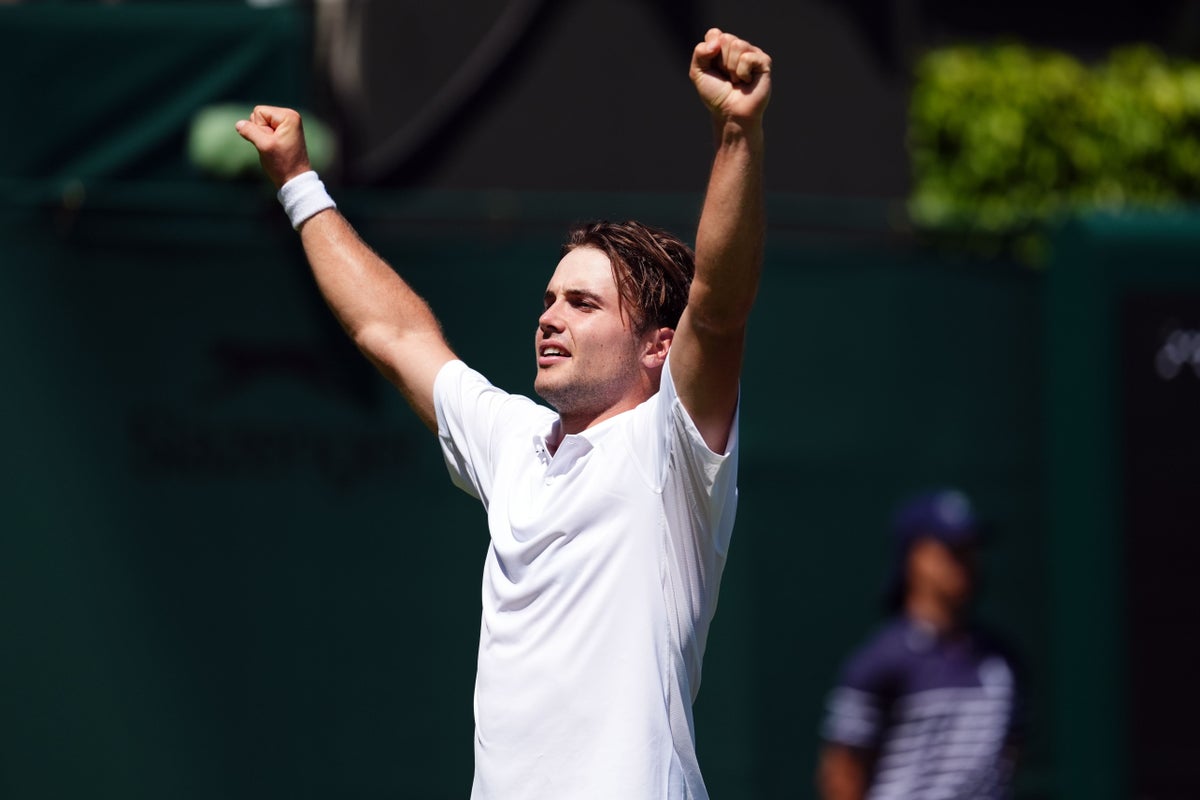
Britain’s last singles hope at Wimbledon has the belief to beat the best and the skills to make up for his small stature.
Arthur Fery reached the third round of a grand slam for the first time with a four-set victory over Otto Virtanen on Thursday and finds himself as the only home hope remaining.
Lawn Tennis Association men’s national coach Alex Ward has worked with Fery for the last 18 months alongside his main coach Jerome Bernard and believes the 23-year-old will embrace the occasion.
“The biggest thing as a person is he’s really got true self-belief,” said Ward. “Not in an arrogant way, but he believes he can beat players that he’s playing here.
“And he goes on court, and he loves it, he genuinely loves being on Court 18 with the crowd, a lot of support. He loves being in those big environments. There’s real, true belief there, which is a massive thing to have, and it’s a tough thing to be taught.”
Fery will be the underdog on Court 18 in his last-32 clash with Belgian Zizou Bergs, who is ranked at a career-high 37 after winning the title in Eastbourne last weekend but still represents a decent draw given the possible alternatives.
Listed at a generous 5ft 9in, Fery is one of the smaller players on the professional tour, and Ward revealed they have studied the games of Dan Evans and Argentinian duo Diego Schwartzman and Sebastian Baez, who are all a similar height, to gain insight.
Ward feels a low centre of gravity can be an advantage on grass, and he said of Fery: “He has to be an exceptional mover, which he is, and he has to be in some ways a better tennis player.
“He’s had to, and he’s done that from a young age, have quite an all-round game, being able to come to the net, to defend, attack, use variation.”
Born in France to French parents Loic, a businessman who is the chairman and former owner of top-flight football club Lorient, and Olivia, a former tennis player who also worked for the LTA, Fery moved to London as a baby and grew up 10 minutes from the All England Club.
He briefly played for France as a junior but came through the British system before choosing to delay his entry to the professional game and study at Stanford University in California.
His progress was held up by a bone bruise in his racket arm – the same injury that Jack Draper is currently battling with – and this time last year he was ranked down at 461.
Victory over Bergs would see him break into the top 100 for the first time and become British number two.
“It was definitely challenging last year,” said Ward of the injury. “Just trying to find solutions. Go through different avenues, change strings, change rackets, different ways of building up.
“At the moment he’s been doing really well with it. He had it for a year and a half, and he’s come out the other side well, but it’s a really tough injury. It’d be nice if somebody had just one answer for it, but people are struggling to find that.”
Ward previously worked with Draper and believes Fery’s progress can provide encouragement for the former world number four, who pulled out on the eve of his first-round match.
“They’re friends and everyone chats in British tennis, so there’s a lot of information sharing between the teams,” added Ward. “It does offer hope for sure.”
Fery’s chief physical concern this tournament has been on-court nosebleeds, a problem Ward revealed they are hoping to resolve post-Wimbledon.
“There’s a plan in place for after the tournament to have a look at that and to try and get that sorted,” he said.