

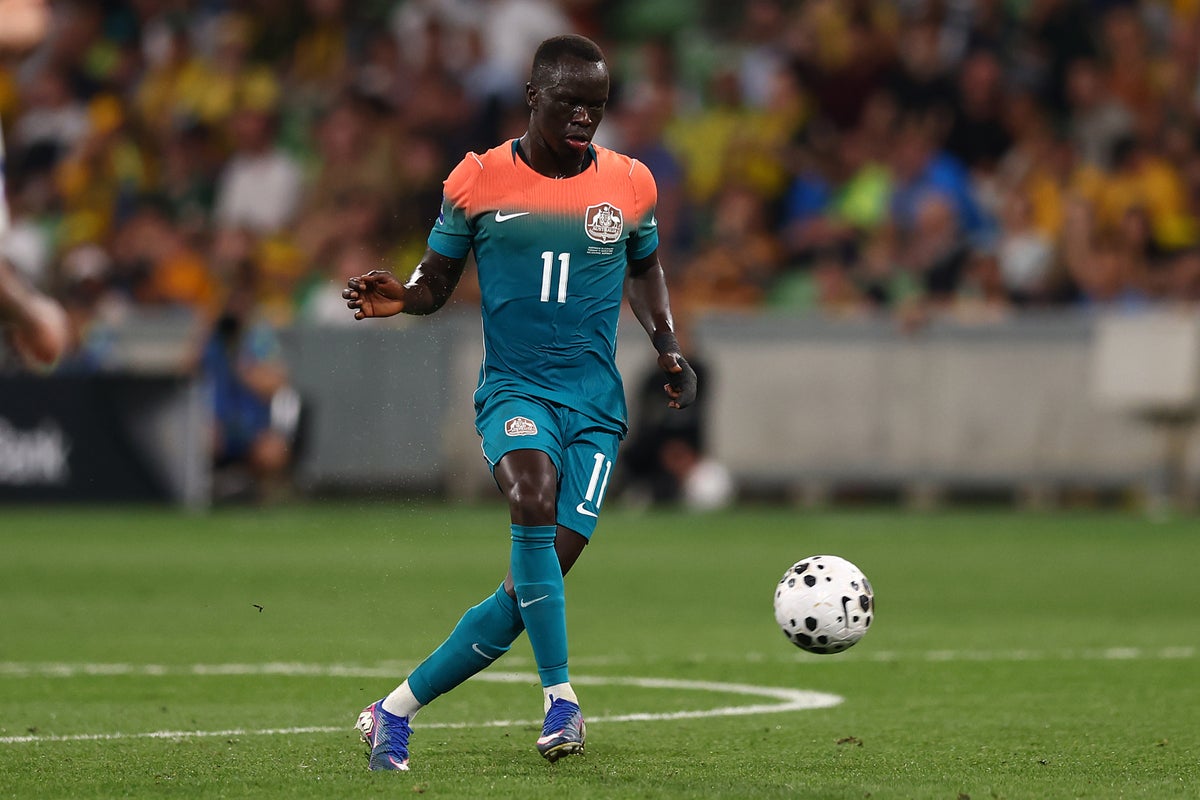
Australian footballer Awer Mabil was visibly moved during a recent media conference, his face transforming into pure joy as he struggled to contain his emotions. This powerful reaction from the veteran forward was not prompted by a sporting victory, but by a profound personal reflection on his past.
Mabil’s sudden surge of feeling stemmed from a poignant memory of his tumultuous youth as a refugee, and the life-changing opportunity he found in Australia. The catalyst for this unexpected moment was the sight of David Basheer, a long-serving commentator for Australia’s SBS network, who had just addressed him from the audience.
The emotional encounter unfolded after a training session on Tuesday, just days before the Socceroos are due to play the United States in a World Cup match this Friday in Seattle.
“I grew up watching you,” Mabil said, so taken aback that he asked Basheer to repeat himself.
A touching moment, in this pressure-packed, every-four-years spectacle, and yet one more example of Mabil’s refreshing sincerity as one of the Aussies’ key faces at this World Cup, no matter how many minutes he plays.
He’s an ambassador from Down Under, to be sure.
Difficult start to life
The 30-year-old Mabil also represents the persistence it took to prevail and get this far, given his daunting path. He was born in Kakuma, Kenya, to South Sudanese parents who had escaped civil war, and he moved to Australia 20 years ago at age 10 through the country’s humanitarian resettlement program. He began playing organized soccer in Adelaide, South Australia state.
It’s fitting that Mabil is sharing his story during Refugee Week, with World Refugee Day on Saturday.
“It’s a Refugee Week and it’s a week that I would like to say to anybody that is misplaced all over the world that we are with you,” he said. “And we are in a world stage right now, in a big tournament — and just to tell you everything is possible, so keep going.”
Mabil is making contributions in many ways. He took part in a video message about diversity ahead of the World Cup that went viral.
The message: “No matter where you come from, football is for everyone.”
“It’s coincidence again that it’s Refugee Week in the World Cup and also at the same time you have many refugees in the team. And at the same time, when I reflect back, I’m like we all belong to this world together,” Mabil said. “And now we’re representing Australia.”
He considers himself a “big brother” to teammates Mo Touré and Nestory Irankunda, fellow refugees from Africa.
A World Cup milestone
The 20-year-old Irankunda became the youngest player to score a World Cup goal for the Socceroos in a 2-0 win over Turkey on Saturday in Vancouver, British Columbia.
The Australians want to show how far the country has come at the World Cup level.
“I hope we’re starting to gain a little bit more respect,” defender Alessandro Circati said. “I don’t want to be the underdogs for the rest of my life.”
Mabil will do his part to help the Socceroos build something special.
He played briefly as a substitute in two group-stage matches four years ago for the Aussies, then didn’t get on the field for the opener this year.
“I’m proud of the boys,” he said. “A lot of the young boys now making the difference for the national team all come through Adelaide, and it’s a credit to the football community.”
He and his mates are loving the omelet bar and lining up for it at their team headquarters, the Claremont Resort and Club in nearby Berkeley. They are training at the former headquarters of the NFL‘s Oakland Raiders.
“Coming in as a senior player I think is more mental that you have to be present for the younger ones. Sometimes you want to slap them,” Mabil joked.
“I’ll play my role to the best of my abilities to be available for the young ones and also the older ones because the older ones also they go through difficulties so they don’t have all the answers — nobody has all the answers. We just have to continue to be there for each other. In these kind of tournaments, it’s very important to remain united.”