

There have been many telling moments on Curacao’s unlikely journey to the World Cup. One of those came more than a decade ago when the Curacao manager, the great Dutch forward Patrick Kluivert, called goalkeeper Eloy Room and persuaded him to commit his allegiance to the Caribbean island.
The pair had something in common: Kluivert’s mother was Curacaoan, and so was Room’s father. At the time, Room had just broken into the first team of Dutch side Vitesse Arnhem and could have pursued a place playing for the Netherlands. But Kluivert convinced him that Curacao’s lofty ambition of qualifying for the World Cup was real.
You could understand Room’s hesitance. Curacao has a population of only 150,000. More people attended the 1950 World Cup final. They had only stepped out from Dutch rule five years earlier, becoming autonomous after the dissolution of the Netherlands Antilles. In a past life the island was a hub for the Dutch Atlantic slave trade.
But Room’s leap of faith would be the start of a domino effect. Room convinced other Dutch-born players with Curacaoan roots to join the project, like his Miami FC teammate Jurgen Locadia. Kluivert’s successor Remko Bicentini took the strategy to new lengths, actively scouting and pursuing potential targets.
The result was a ragtag squad of players schooled in Dutch football, who shared Caribbean heritage and who dreamt of one day playing at the World Cup.
As the details of this 2026 World Cup became clear, Bicentini dangled a carrot. A 48-nation tournament in which three of their Concacaf competitors were hosts, and therefore not taking part in qualification, represented a unique opportunity. These players might never get another chance like this one.
The veteran Dutch manager Dick Advocaat took charge in 2024 and what followed was a qualification phase of absurd drama. Curacao had to avoid defeat to Jamaica, in Jamaica, in their final game. The Jamaicans hit the woodwork three times and then won a penalty deep in stoppage time. But VAR intervened, and Curacao survived.
“All the emotions were flying up in the air. He goes to the VAR and he says ‘no penalty’,” winger Kenji Gorre told the Guardian. “My heart just dropped again and we were like, wow, we are actually going to the World Cup. This is destiny. This is meant to be.”
“It means everything,” Room told Fox Sports after clinching their World Cup place. Room now has a tattoo bearing the nickname of the Curacaoan goalkeeper from the 1952 Olympics, Ergilio Hato, who was dubbed “the Black Panther”.
“This was the main reason I started to play for Curacao, because we had that dream. Back then we were told, ‘It’s going to be a long road, it’s going to be a bumpy road’. But I really believed we could reach the World Cup. I don’t know what it was, but I had this feeling inside of me that we can make it.
“It’s an unbelievable feeling that you started something 10 years ago, and at the end you make it, you know? A lot of people said, ‘Nah, you’re never going to make it. It’s too difficult.’ We proved we can, so that makes it extra special.”
The players were welcomed back to the island as heroes, parading through the capital city, Willemstad, on an open-top bus as thousands of fans came out to greet them.
“We have made history,” said defender Sherel Floranus. “We are writing our own history, for this island.”
They are far from the only international team to recruit overseas-born players. Morocco, Senegal, DR Congo and Haiti are among a number of others who have a worldly squad with them at the World Cup. But none have pulled it off so dramatically, so effectively, with such limited resources, enticing an entire squad to travel 5,000 miles on the promise of an almost impossible dream.
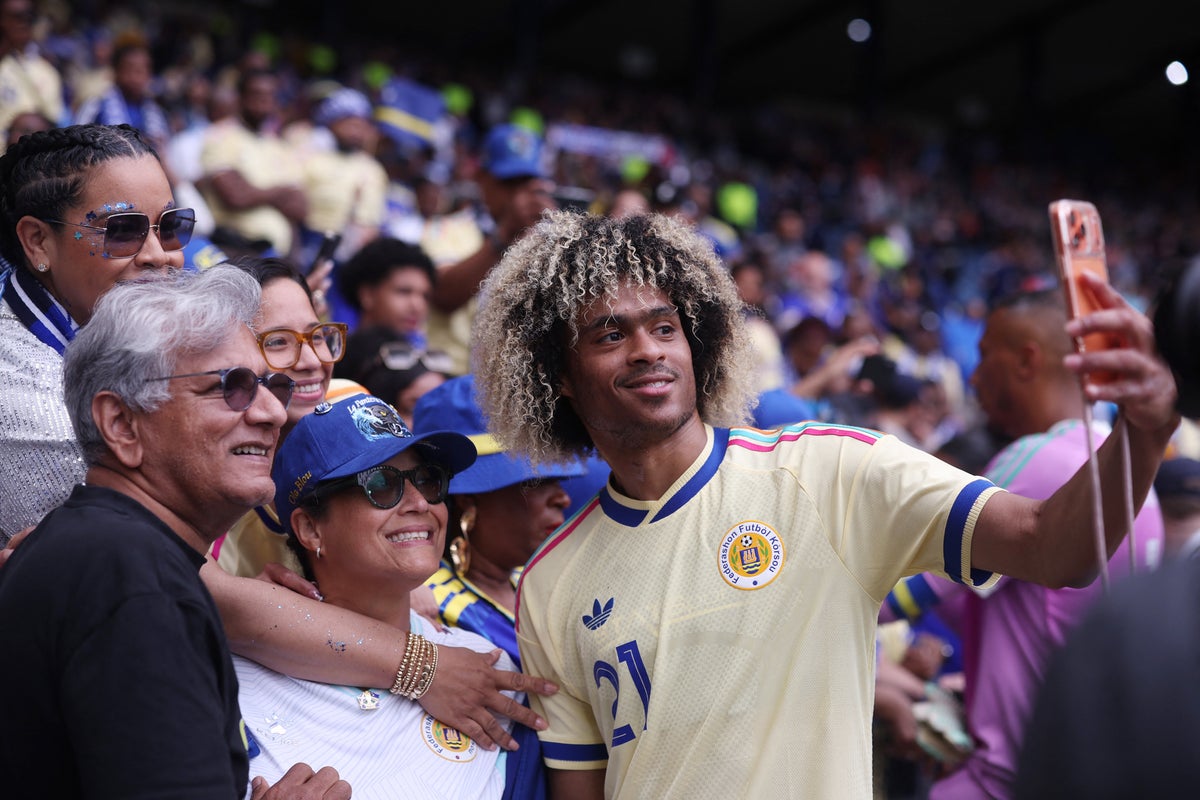
The only Curacao player at this World Cup who was born on the island is Tahith Chong, the Sheffield United midfielder formerly of Manchester United, who left as a young boy to join Feyenoord’s academy. Chong scored twice and assisted the winner in a dramatic 3-2 victory over Bermudu in qualifying.
Asked why he chose to represent Curacao over the Netherlands, Chong replied: “That’s where I call home.”
Advocaat has had a huge impact, increasing the noise around the team and bringing sponsorship money with him. He admits he made a mistake in trying to stop the players from singing and dancing before matches, later accepting he had to protect the soul of the team.
“We started building, but by first going back to the basics,” Advocaat said. “We never had anything to complain about regarding the passion and commitment of those guys. But we had to provide a foundation, to establish organisation. It was pleasing to see that this was quickly picked up and yielded results.”
Curacao have taken a relaxed approach at their training base in Florida, refusing Fifa’s offer of security at the hotel, allowing friends and family to stay with the players and letting fans mingle with their heroes. Advocaat is well aware they are at the World Cup for a good time, not a long time, in a tough group with Ivory Coast, Ecuador and Germany, who they meet in Houston on Sunday.
It will be difficult, but the expanded format does at least give the minnows a chance to reach knockout stages. Finishing third with three points is projected to be enough for some teams to make it through to the round of 32. And Curacao’s 78-year-old manager knows all about World Cup upsets, having led South Korea to the semi-finals in 2002.
“We have proven that we are difficult to beat,” Advocaat said. “The opponents in this group are of a different quality, of course. We know it will be very difficult. But nothing is impossible.” Curacao’s remarkable journey has already proven that.
The future looks bright. The Dutch Football Federation has signed an agreement with Curacao to invest in its football structures, helping to provide referees, coaches and expnding its youth and women’s programmes. There is a determination that this once-in-a-lifetime opportunity will be experienced by future generations of Curacaoan players.
“We have an obligation to represent Curacao in a way that inspires the next generation,” Chong said. “So that maybe in 15 or 20 years when Curacao qualifies for another World Cup, kids come in and say, ‘I started playing because of the 2026 World Cup. The team that went to that World Cup inspired me to play.’”