

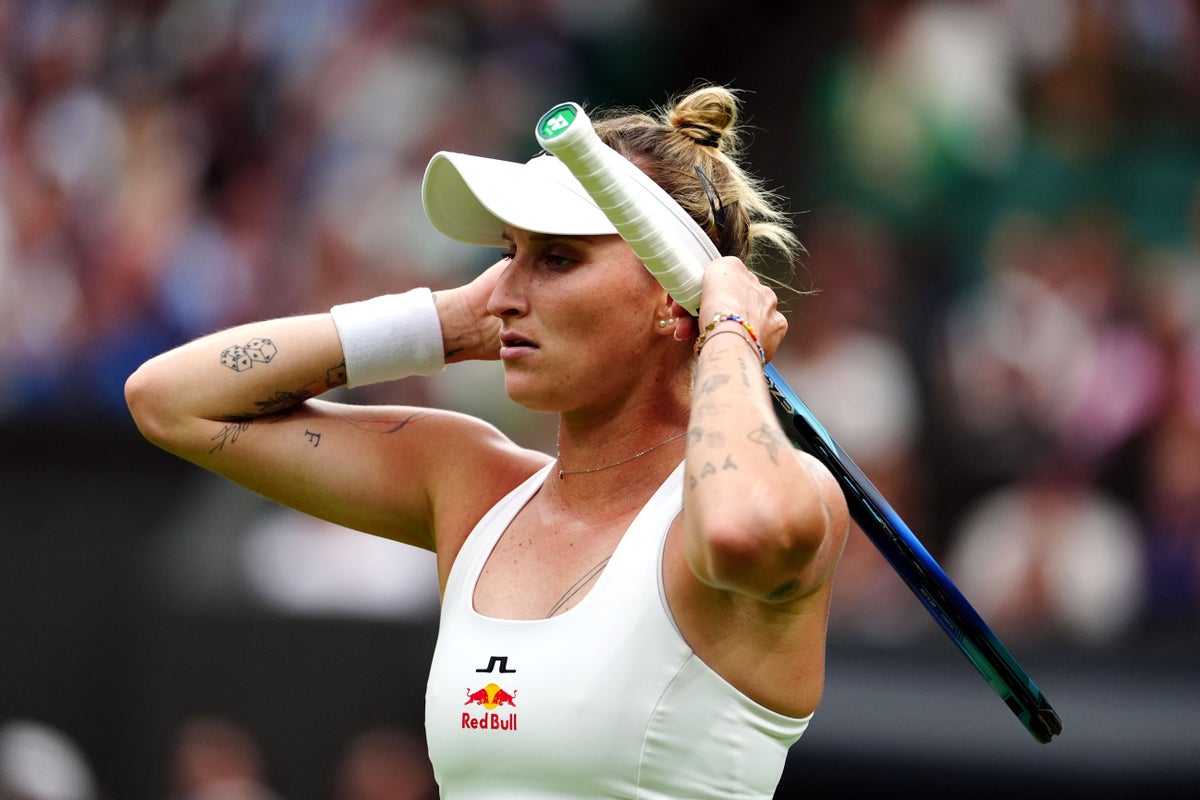
The Professional Tennis Players Association (PTPA) has called for players to be given a greater say in rules on doping testing after former Wimbledon champion Marketa Vondrousova was handed a four-year ban for missing a test last year.
Vondrousova, who won Wimbledon in 2023, refused an out-of-competition doping test in December 2025, saying she had “reached a breaking point after months of physical and mental stress” and that the incident resulted in an acute stress reaction.
She said the visit from a doping control officer, which occurred at 8.15pm at her home, was a “serious intrusion” into her privacy. The visit occurred outside the set window she had provided to doping authorities for testing; tennis players are required to log their whereabouts for an allotted hour each day so they can be tested outside of competition, although tests can also take place outside these times.
Vondrousova explained during the hearing that stress and poor mental health affected her decision-making, as well as concerns for her safety, and said that the tester failed to properly identify themselves.
In a social media post this April she explained a knife attack on her compatriot Petra Kvitova, who was stabbed and seriously hurt by an intruder at her home in 2016, made her fear opening the door to strangers.
An independent tribunal convened by the International Tennis Integrity Agency (ITIA) said the evidence Vondrousova provided offered “no compelling justification” for her refusal of the test, and banned her from the sport until June 2030.
The severity of her ban has led to criticism from some quarters. Several WTA players wrote messages of support on Vondrousova’s social media, while German player Eva Lys wrote on X: “This is completely insane. Sending so much love to Marketa.”
The sport’s anti-doping authorities have had to fend off criticism after high-ranked players like Jannik Sinner and Iga Swiatek avoided long bans for failing drug tests, and the PTPA urged a more meaningful athlete voice in rules governing them.
It said: “Without weighing in on guilt or innocence: a four-year ban for a player who has never tested positive, and who said she feared for her safety when an unidentified person came to her door late at night, should give this sport pause.
“We defend testing. But players deserve a real voice in the rules that govern them.”
Last year, the PTPA filed a lawsuit against the governing bodies of tennis, accusing them – among other things – of violating players’ privacy rights with random drug tests.
Since tennis came under the World Anti-Doping Agency code, its rules have aligned with a system applied to athletes across all sports, with the ITIA saying cases are determined by facts and evidence, not a player’s name, ranking or nationality.
“We understand that the testing process is uncomfortable, and acknowledge that it is an additional burden for players whose jobs already come with a high level of pressure and scrutiny, but it is essential to protect fair competition,” ITIA chief executive Karen Moorhouse said on Monday.
Former world No 6 Vondrousova, who has not competed since January due to a shoulder injury, can appeal the ban to the Court of Arbitration for Sport.
With Reuters