
More than a decade on from Lance Armstrong’s disgrace, cycling is still unable to shake the shadows of its past. The sport’s paranoia over doping and its inability to ever truly prove itself has been in the spotlight again this week, as a result of some unusual measures to combat doping which have possibly had unintended consequences.
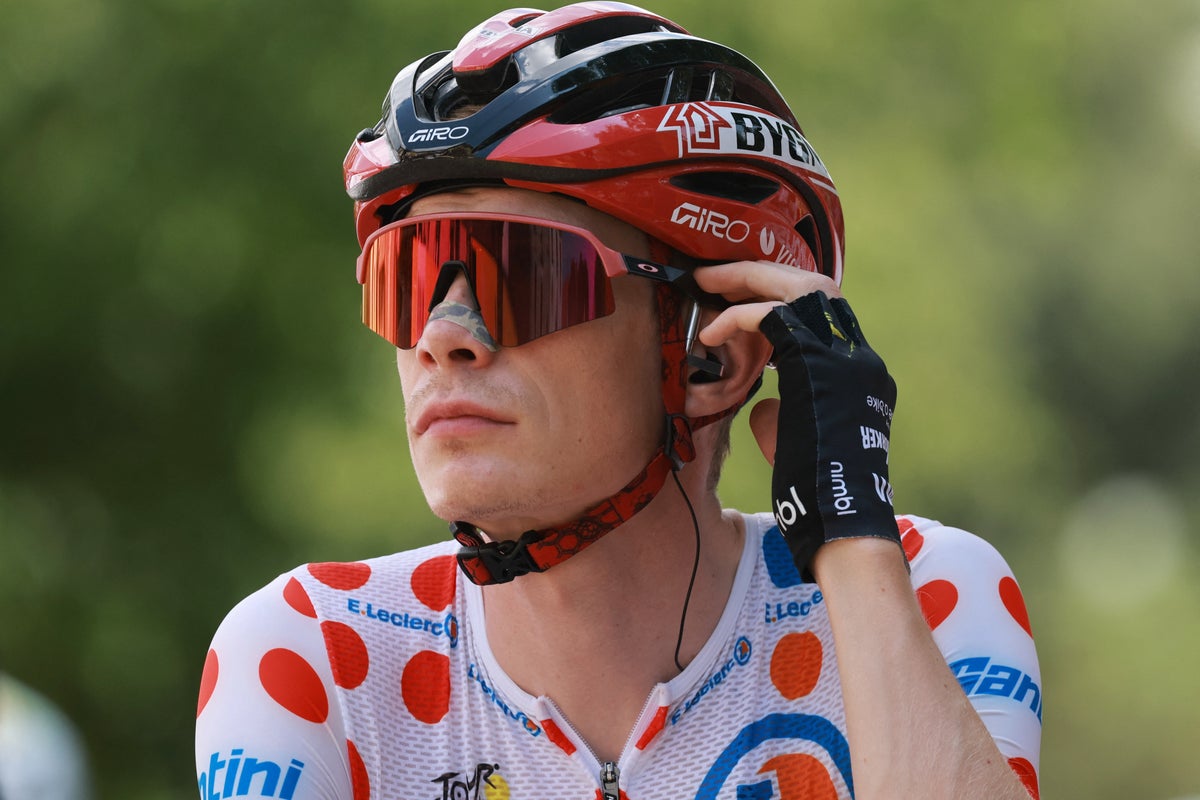
Two-time Tour de France champion Jonas Vingegaard and race leader and four-time winner Tadej Pogacar were both woken in the small hours of Sunday for out-of-hours doping tests. Visma-Lease a Bike’s Vingegaard was woken up at 2am, Pogacar at 5am; the latter said he could not get back to sleep afterwards. The tests occurred mere hours before a difficult mountain stage heading to the hors-categorie climb of Plateau de Solaison in the Alps, a key point in the three-week race.
The regulations of the Union Cycliste Internationale (UCI), cycling’s governing body, state that usually riders are tested between the hours of 6am and 11pm, with riders required to give one-hour whereabouts windows each day and accept that they may additionally be tested outside those times. The UCI has delegated responsibility for doping controls to the International Testing Agency (ITA) since 2021, and the latter required permission from the World Anti-Doping Agency (WADA) to conduct these nocturnal visits, as well as from a Parisian judge.
Those tests raised eyebrows because of their unusual times but may not have led to anything else, had Vingegaard not crashed out of the race that same day.
What seemed an innocuous crash on an awkward but otherwise inconsequential piece of road has acquired greater significance in light of the fact that his sleep was heavily disturbed by the 2am call and could possibly have led to lapses in concentration during a hard day’s racing. The Dane is not prone to crashing; he had never previously abandoned a grand tour and had come through five Tours de France unscathed. It is certainly an unusual occurrence.
His Tour is “ruined”, as Pogacar put it, and the Slovenian, as well as other riders and commentators, openly speculated that the late-night doping test may have played a part. Remco Evenepoel, who won stage 15, described the 2am call as “inhuman”.
Cycling’s most famous doper – Armstrong – then accused anti-doping officials of “human rights issues”, although it feels as though you must take any of the American’s proclamations on drug-related issues in the sport with a pinch, or perhaps vat, of salt. Either way, it has sparked a furore around whether such out-of-hours testing is fair to the riders, or necessary at all.
The whole point of night-time doping is to catch riders micro-dosing performance-enhancing substances such as EPO, which would otherwise go undetected. The UCI’s own rules say as much: “It is known that some riders use low doses of EPO during these hours so that it will be undetectable in the morning.” There is a clear case to be made for the sport to permit this sort of testing given its heavily chequered past.
Former rider Jonathan Vaughters, who admitted blood doping on the US Postal team and who now manages the EF Education-EasyPost team which is riding the Tour, wrote on X: “If [the] UCI had tested us in 2001 at 2am? We’d all have been suspended and saved the sport 25 years of drama.”
Twenty-five years of further drama is what the likes of the UCI and ITA are trying to avoid. And the late-night testing is by design highly unusual: the UCI’s own regulations say it will not test between the hours of 11pm and 6am “unless it has a serious and specific suspicion that the rider may be engaged in doping”. Cycling Weekly has reported that a number of teams, believed to be up to eight, have also been subjected to night-time testing at this Tour, suggesting that the governing body has widespread “serious and specific” suspicions about a number of riders, or teams.
We may never know the results of any of these tests – the ITA said that like all tests it conducts, the outcomes “would be published according to our public disclosure policy, only in the case of an apparent anti-doping rule violation”. But if they have been as prevalent as has been reported, that suggests there is significant paranoia about doping in the current edition of the Tour. We can only hope that that is unfounded.
But is it fair to disturb riders in the middle of the night for a doping test, when recovery is so crucial to the utterly gruelling experience of riding a grand tour, and so hard to come by? Perhaps the bigger question is whether testing the integrity of the sport in this way more important than playing fair?
Pogacar himself seemed resigned to it being a necessary evil. The race leader said on Sunday that he “totally accepts” the irregular tests “if this is necessary to prove that we are riding clean”.
Vingegaard, whose Tour dreams have been crushed, is a very measured character and struck the sort of note one would expect from him. He said: “It’s good that they test, but when it’s affecting performance and your sleep, I don’t think it’s so good.” He refused to say his crash was to do with his lack of sleep: “I don’t want to blame it on that, because it’s a bicycle race, and crashes happen in bicycle races.”
Evenepoel, now up to second overall, is a far more outspoken character and he was blunt in his assessment: “It’s inhuman and this is something we actually should not accept as athletes, because everybody knows sleep is the only recovery that we have in the night. This is the hardest and the biggest race in the world. This is a shame that this happened, and I hope it doesn’t happen any more in the future.”
Which gets to the fundamental point. Riders are aware that doping controls are a fact of life and cycling more than any other sport has to bear the cross of its past. But in a sport as inherently unsafe as cycling, which has seen several riders killed in horrific crashes in recent years, everything must be done to keep them as safe as possible – including letting them recover between long and exhausting days of racing. Vingegaard himself said he “luckily” only sustained a broken collarbone. It could have been much worse.
The ITA said it was “conscious that night-time testing may be disruptive to riders’ rest and recovery. Due consideration has therefore been given to minimise as much as possible the impact testing activities have on riders.” But it added it “has the responsibility to ensure the effectiveness of the cycling anti‑doping programme and the integrity of cycling races”. It is stuck between a rock and a hard place.
Funding for anti-doping testing in cycling has heavily increased since the ITA took responsibility for it in 2021, but there has not been a slew of positive tests since then. Either the mechanisms to cheat are becoming more sophisticated and the methods of detection poorer, or cyclists really aren’t cheating the way they used to.
The anti-doping process is deliberately opaque and unpredictable so dopers can’t get one step ahead of the authorities, but that also means the authorities aren’t required to explain, or able to justify, their decisions, either to the riders or the public.
You can’t prove something you can’t catch; that is the issue the ITA and UCI are wrestling with. Riders are aware of it too – they have to support the anti-doping authorities, because cycling has a lot to atone for, but equally they have to protect their own health, especially at one of the toughest sporting events on the planet.
The 2am testing is here to stay – but whether it should be is another matter, and another question for which the sport has no easy answers.