
Over the last few years several surprise names have cropped up late in the French Open women’s draw. Last year it was home favourite Lois Boisson, only the third woman to make the semis of a grand slam on her main-draw debut. In 2022 it was the unseeded Martina Trevisan; in 2021, Tamara Zidansek.
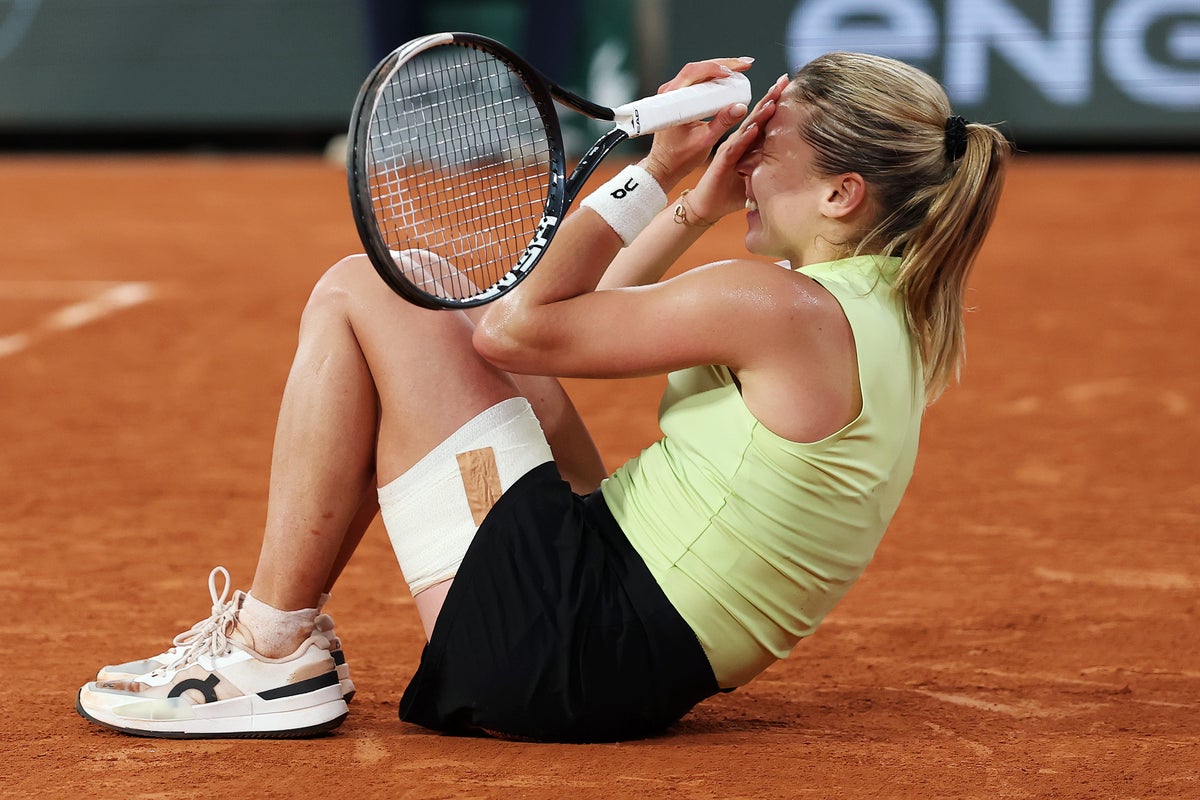
All three of those pale in comparison to the fairytale story of Maja Chwalinska, the 24-year-old from Poland who dropped to the red clay in shock as she reached the Roland Garros final. Chwalinska (pronounced ‘hva-leen-ska’) has made history with an unprecedented run, winning nine matches to become the first qualifier to reach the final in Paris, and only the second to ever do it at a grand slam.
For all the recent run of slightly left-field candidates to perform echelons above expectations at Roland-Garros, Chwalinska is the most unlikely, and the most impressive, of the lot. Comparisons have inevitably been made to Emma Raducanu, but the Briton exploded onto the scene as a teenager during a starry 2021 season; her US Open win, however unlikely, was the steep peak of a nonetheless steady upward trajectory.
Chwalinska, despite only being 24, has been around for significantly longer and has been plying her trade on the lower-tier ITF and WTA 125 circuits, never breaking into the elite. She reached the Australian Open girls’ final in 2017 but took time to convert that promise into a singles career. She had never beaten a top 50 player before this week and had only won one grand slam main-draw match, at Wimbledon in 2022, while a knee injury required surgery that same year and stalled her career.
Other qualifying campaigns at slams had ended in heartbreak. A first-round loss in Wimbledon qualifying in 2019 propelled her to take a break from the sport after two years struggling with depression, saying she associated the sport with “pressure, stress and crying”.
“I was struggling a lot. I pushed at the beginning,” she said of her emotional state before her hiatus. “I thought that I just need to stay very strong, tough, and just keep practicing. But then I just couldn’t get out of bed anymore. I was just lifeless, to be honest.
“I needed to take a break, and I honestly didn’t know if I was going to come back or not. I needed to kind of figure a few things in my head, I would say. … And I came back. I’m happy that I did.”
Getting professional psychological help, returning to her family home in Poland, and picking up other sports like boxing for fun helped her reset, and she eventually returned to tennis with renewed enthusiasm. A year later she successfully qualified for Wimbledon, upsetting Coco Vandeweghe to make the main draw, but she had to wait until this year to really break through.
She has done so in stunning fashion, beating Qinwen Zheng, who won Olympic gold on the Roland-Garros clay two years ago, and three seeds – Elise Mertens, Anna Kalinskaya, and Diana Shnaider – en route to the final.
While she is undoubtedly a surprise finalist her run highlights the strength in depth of the women’s tour, and the great leveller that is grand slam tennis, and particularly, the live surface of clay.
“I think the level is very close, like, qualifying is not much worse than the main draw,” Chwalinska told media. “And the players in the qualifying are so good, as well. They are great competitors. We just need to fight, and just believe that maybe some day it will click for us, as well.”
Chwalinska’s unconventional play style has provided sharp contrast to the power and pace of many of her opponents – and she herself has happily described it as “annoying” for other players to face. She has won all three of her WTA 125 singles titles and a further three doubles trophies on this surface. With its variety, spin, and frequent use of moonballs and drop shots, her game is well-suited to the slower conditions on clay, but her mental fortitude and quiet determination has been equally crucial to the way she has stormed through the draw.
The Pole’s court craft and intelligence is underpinned by an analytical approach and a general air of calm, an unflappability that she will need to fall back on amid the heightened emotions of a grand slam final.
A self-described “tennis freak”, Chwalinska grew up idolising the Big Three (Roger Federer, Rafael Nadal and Roger Federer), describing their classic matches as “like poetry”. “I love watching tennis, when I was younger, I watched tennis all day every day,” she told the press. “So I feel like it really helps me with reading the game better.”
She is rarely emotional in the process of competing but her relief and shock was immediately apparent as she dropped to the red dirt after beating Shnaider in the semi-final, before she hid her face in a towel and cried happy tears.
Her run has come out of nowhere and caught everyone by surprise: she had no sponsors at all for her early appearances in Paris, before adding more and more short-term ‘patch deals’ with sponsors to her kit as her fairytale continued. Polish drinks company Oshee, which sponsors her former junior doubles partner and six-time major champion Iga Swiatek, stepped in to help as the expenses from an extended stay in the French capital racked up. She has already tripled her career prize money and, like Raducanu found in New York, her life has changed irrevocably.
On the other set of the net on Saturday will be a player from very different circumstances: teenage prodigy Mirra Andreeva, also a first-time slam finalist but the eighth seed and overwhelming favourite.
Chwalinska’s anonymity has now become notoriety, but she remains an unknown quantity for Andreeva. The Russian has never played her and could only blink in awe and surprise as she was told the Pole won her first set against Shnaider in an hour and 20 minutes.
Saturday’s final will be a fascinating contrast of Andreeva’s power and clean, brutal groundstrokes and Chwalinska’s maverick gamestyle. The softly-spoken 24-year-old, who has maintained a serene assurance throughout this tournament, will be hoping that once more she can “annoy” her way to victory, and write the next chapter in this fairytale.