

There are a raft of reasons why Germany have been so disappointing at recent World Cups, but sometimes the most obvious is the most telling. Germany haven’t had an elite striker since Miroslav Klose, and it has shown.
Arguably, they still don’t. Most football fans probably couldn’t name the player wearing Germany’s No 9 at this World Cup, someone with five caps and one international goal, Stuttgart’s attacking midfielder Jamie Leweling. The question is, can Germany go deep in the World Cup without one of the tournament’s leading strikers?
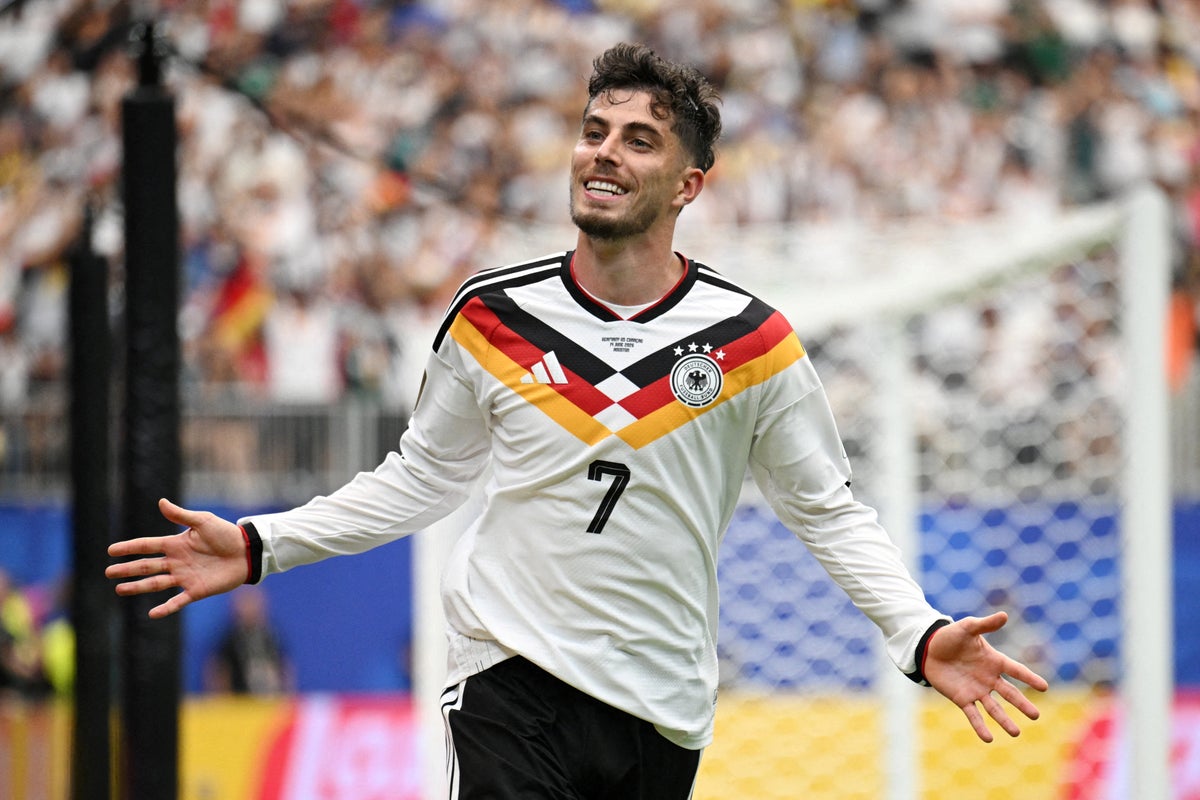
Their first game, admittedly against limited opposition, was promising as Kai Havertz led the line and scored two goals in the 7-1 win. Jamal Musiala was also on the scoresheet and Florian Wirtz was involved in a lot of Germany’s best play. Deniz Undav, an out-and-out striker, came off the bench to score and assist.
The goals will need to be shared over the coming weeks, but it is Havertz who is the key to Germany’s attacking success. Havertz drifted deep and wide at times but also acted as a focal point for his teammates to play off. His international goal record is good, with 24 goals in 59 games, and there is the sense here that if he has a good World Cup, Germany will go far.
The country’s third highest goalscorer, Thomas Muller, is convinced.
“Kai Havertz is an anchor player for this team,” Muller said. “He is clearly set as the No 9, and if possible, he should play every single minute. Especially against big teams, he becomes even more crucial than against smaller ones. So, I want to see Kai Havertz on the pitch every minute. If he can’t run anymore, then we can put someone else in. We have Undav and other wonderful players waiting, but Kai is my man.”
Muller was at the heart of Germany’s only modern World Cup triumph in 2014. It was the result of a root-and-branch overhaul of German football more than a decade earlier, dubbed Das Reboot, a change not only in approach and resources but of mindset, embracing modernity, technology and a more possession-orientated brand of football.
As Philipp Lahm lifted the World Cup, no one could have foreseen the collapse that followed. They failed to progress from their group in both Russia and Qatar, and lost in the round of 16 at Euro 2020. Germany have not played a World Cup knockout game since Mario Gotze’s goal won the final in Rio de Janeiro 12 years ago.
So they are enjoying something of a mini reboot again. Julian Nagelsmann seemed to find the right blend and balance, which is not something that has always been said about Germany under his coaching.
“We played with the right intensity, if we do that we can have a good tournament,” Nagelsmann said. “We really needed this convincing win, and the confidence it will give us. That confidence was always there, but it has grown. It was important to show the people in Germany that we can perform.
He added: “After the game, there was a song (from the German fans) called ‘the train has no brakes’. We will try to do that, to keep going and going in this tournament.”
There remain some question marks around the side. Leroy Sane is not hugely popular at home and his one-on-one miss in the second half here won’t have helped his reputation. The fact Nagelsmann recalled a 40-year-old Manuel Neuer is not a ringing endorsement for the next generation of German goalkeepers.
Then there is the role of the captain, Joshua Kimmich. Lahm was famously moved from midfield to right-back by Joachim Low in 2014, a key tactical decision which probably changed the course of footballing history. Perhaps the opposite might end up being true here. Kimmich has played in midfield for Bayern Munich this season but started this game at right-back, and was on the periphery.
But as ever with this modern German team, they are just deckchairs on the Titanic unless the team has a reliable striker. Truer tests await, starting with the Ivory Coast on Saturday. But if Havertz can be Germany’s goalscoring No 7, they will soon be restored as a threat in the knockout stages of the World Cup.