

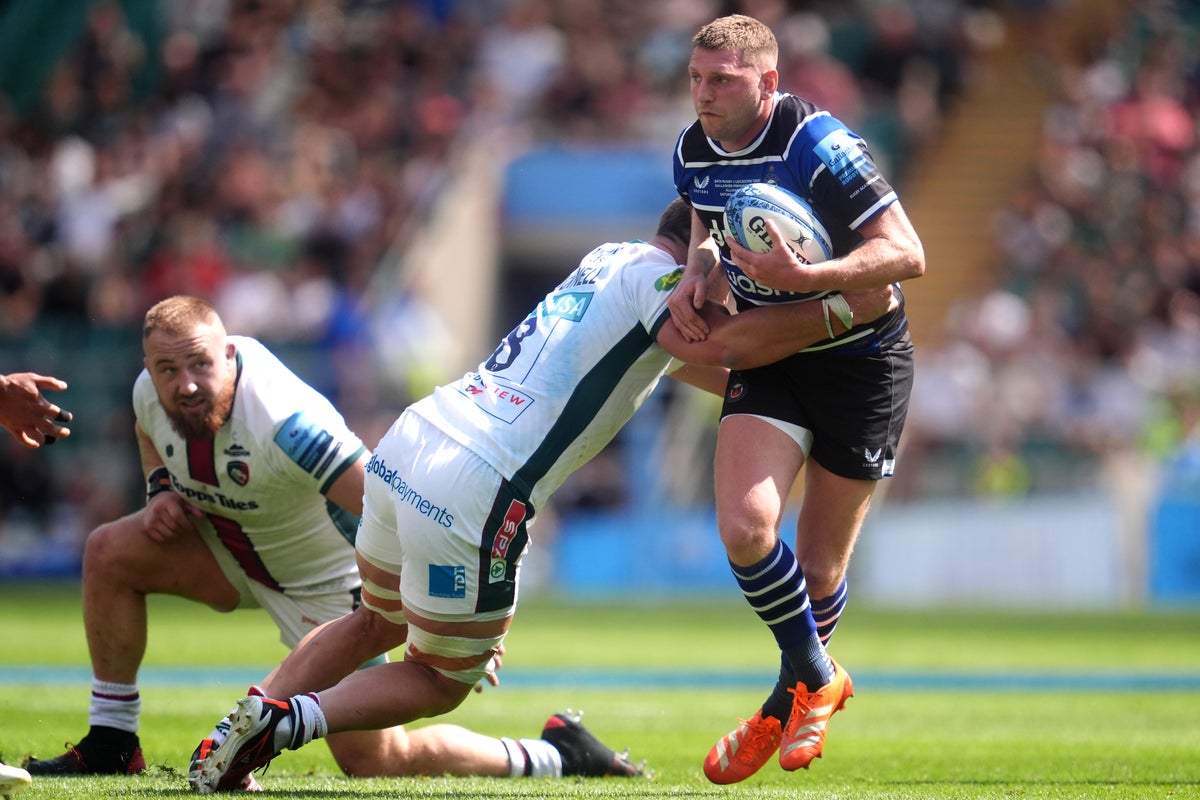
Perhaps we were wrong to ever doubt Gallagher Prem’s capacity to deliver drama and jeopardy. It was not that long ago in this strange season where the campaign looked to be ebbing towards a damp squib; the play-off chase all but decided, the top two clear and relegation removed to leave little to play for.
But the final weekend of the regular season arrives again with the promise of compelling competition. Second-placed Bath host third-placed Leicester needing a victory to return to the Rec a week later for a semi-final; Northampton will host the other, with their opposition likely to be the victor in a play-off play-in game between old rivals Exeter and Saracens. There is even a wrangle at the bottom to sort with the battle for eighth place mattering more than might first appear; Gloucester and Harlequins take on the roles of the proverbial bald men fighting over a comb, though the successful side will at least have the promise, perhaps, of the golden locks that come with qualification for next season’s Champions Cup.
Only really, then, will the squads of Sale and Bristol – semi-finalists last term – consider themselves contesting a dead rubber. It is testament, even in a season of too many lopsided scorelines and weak defences, to the competitive balance established within the English top flight. The make-up of the top four will guarantee an end to a six-year run of different Prem winners but within that is a rudeness of on-field health that is beginning to be matched off it. While Newcastle have been cut adrift at the bottom, Red Bull’s riches have brought fresh impetus and eye-catching recruitment; their arrival, and the official ring-fencing of an “expansion” league, has catalysed conversations elsewhere, with James Dyson investing in Bath and the owners of AFC Bournemouth set to complete a takeover at Exeter.
Certainly, then, there has been a different tenor to the topics on the table of Prem Rugby’s chief executive Simon Massie-Taylor in recent months. Such a change is welcome for a figure whose first 18 months in the role were spent in a whirl of three clubs entering administration, a hauling over the coals in parliament and the natural uncertainty that came with the emergence from covid.
“We’ve got a situation now where we have a very committed group of owners, some of which have been there for a long time,” he explains of a league most clearly in a phase of change. “I think some are, naturally, thinking about legacy and what happens next. That’s part of the reason we’ve made the changes that we have – so they’ve got options and are able to partner with other people if they need to.
“I think it has been a two year process in terms of changing the conversation that we are having with the market. That started with Red Bull, which in itself took a couple of years in terms of them committing themselves. But even then, if we look back two years, there was still a lot of uncertainty. I don’t think we’d secured our long-term TV deal [with TNT] then. What was underlying for Red Bull specifically was how strong the sport is, and its growth potential. They saw that. In a market, that just generally starts to generate interest. And things start snowballing quite quickly, really.”
Massie-Taylor speaks not as a man counting unhatched chickens, but as an individual fielding fascinating calls all the time. We chat on a balcony at the Oval on the day of SportsPro, a congregation of some of sport’s most powerful people and therefore a useful room for an investment-hungry CEO to be in.
“The amount of inbound now is legit. So it is, therefore, what do you do with it? And a lot of the time it is, ‘thanks for your interest, we’ll let you know when there are opportunities’.T here will be a point soon where it is not necessarily about finding investment for the current Prem clubs, but for the expansion clubs. The trick will be being able to match the investor interest with the blueprint for expansion clubs. I’m enjoying that bit of it. It’s exciting work.”
Massie-Taylor is coy over committing to any details but the assembly of a “club office” to consider possibilities is well underway. Yorkshire and the south east have been looked at in depth as two possible areas of opportunity; he cites the Melbourne Storm of the NRL and Brooklyn Nets of the NBA as success stories he contemplates the challenges of building new audiences.
“In sport, it is all about culture and identity a lot of the time. This is why the concept of artificial teams and leagues don’t necessarily resonate or take off. You need to be able to tell a story. If there is a latent audience, you are halfway there. So how do you genuinely create an identity that people can latch on to? I don’t think that has happened in rugby yet.
“What is comforting is that a lot of what our core fans like about the sport are the same attributes as our potential fans and younger fans want. The athleticism, the skill, the ferociousness. We are not having to pretend to be one thing to one group and one thing to another. The trick is you can communicate that in different ways to them much more easily these days.”
The drive for growth will naturally bring about familiar conflicts. Mark McCall, whose trophy-laden tenure with Saracens could conclude this weekend, articulately explained the need for league expansion this week, with nine home Prem fixtures a season too few to sustain a professional club. The further crowding of an already saturated calendar is an unfortunate if unavoidable byproduct – but Massie-Taylor believes there is a spirit of collaboration and compromise that English rugby has perhaps lacked in the past.
“We study a lot in terms of ‘why do other systems work?’ Which model do you copy? What bits do you take? You land back on a pretty firm view that, within our system, the best set-up is where there is a shared partnership between England and the clubs.
“A winning England is fundamental, I think, to growing the legends and heroes that will help grow our league. And then there is the realisation from the RFU throughout this whole thing that you need a thriving Prem to deliver a winning England and to help grow the game. There is a respect for the level of risk that the club system takes to deliver that. That is where the group loss tends to exist, rather than at the RFU. The ownership structure of the Prem means that, ultimately, the buck stops with them. We’ve landed very confidently on a long-term partnership because we both think it is essential.”