

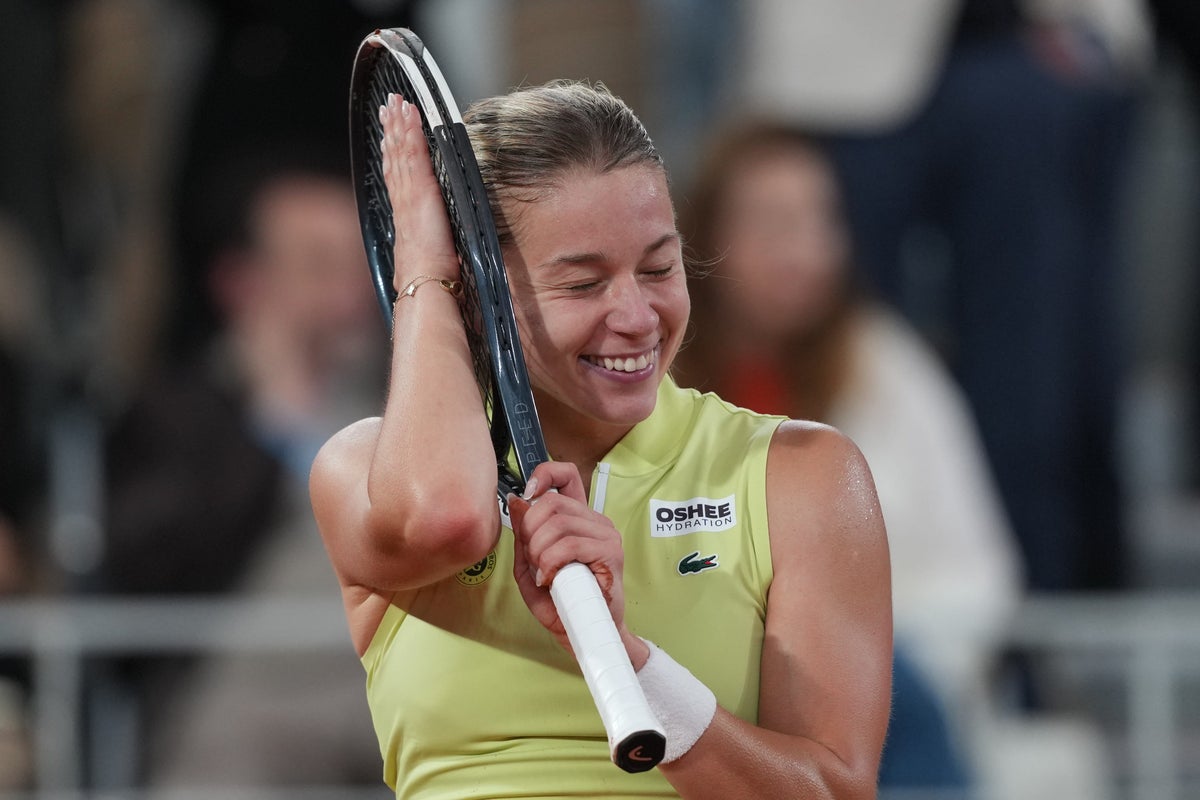
Emma Raducanu’s status as the only qualifier ever to win a grand slam title could be erased on Saturday by remarkable Polish outsider Maja Chwalinska.
The 24-year-old’s 7-6(4) 6-4 victory over Russian Diana Shnaider on Court Philippe Chatrier was her ninth in a row at Roland Garros, and set up a final clash with eighth seed Mirra Andreeva.
Chwalinska, who is ranked 114th, arrived in Paris as one of 128 players just hoping to make it through to the main draw and without ever having beaten a top-50 player.
Now she has toppled four in a row as well as Olympic champion Zheng Qinwen, and will fully believe she can match Raducanu’s fairytale run in New York five years ago.
The Pole produced her best performance yet to see off 25th seed Shnaider, who went from the high of defeating world number one Aryna Sabalenka to being bamboozled by a qualifier in 24 hours.
Chwalinska has an unorthodox game based not on power but on an intelligent use of spins and angles, creating a puzzle that none of her opponents have so far been able to solve.
The first set alone lasted longer than Andreeva’s 6-1 6-3 victory over Marta Kostyuk earlier, and Chwalinska got better and better.
After a final winner flew past the stranded Shnaider, Chwalinska collapsed to the clay in delight and disbelief, and she had to pause before her on-court interview while the crowd chanted her name.
“Like a dream,” she eventually said when asked how the achievement felt. “I don’t know what’s going on. I don’t know what to say.”
At 19, Andreeva was the youngest player left in the last four but also the most experienced having reached the same stage here two years ago.
The Russian is a prodigious talent but it is attaining a new level of emotional maturity that has helped her break fresh ground here with a first slam final appearance.
“Before, I was nervous,” said Andreeva, who has suffered several on-court meltdowns.
“Now I’m also nervous when I play matches like this or when I’m up in the score and I’m serving and the opponent breaks me. Before I was thinking that, ‘Oh, my God, if I lost my serve, it’s like the end of the world’.
“But now I feel like, if she broke me, well, so what? I will try to break her back. Because, if I get nervous when I serve, I think she also can get nervous when she serves.”
Andreeva said she had found such a level of focus during the match that she had been “seeing the little hairs on the ball”.
The teenager’s performance was particularly impressive given the extra tension around the contest of a Russian facing a Ukrainian.
Kostyuk has used her run here to highlight the continued plight of people back home, including showing a picture during her first press conference of the aftermath of a missile strike metres from her family’s house in Kyiv.
“I will never forget the ovations I received after my match in the quarter-finals,” said the 23-year-old, who had won 17 matches in a row on clay.
“This is something I will carry with me forever. I will never believe anyone who is at the world stage of this sport saying they have zero influence or anything, because I experienced this myself.
“If you want to, you can do anything, and this was a proof for me. I obviously am very happy I made it to the semi-finals, but I feel like this is the highlight of my tournament.”