
Scotland left the World Cup with a lasting legacy. Of sorts, anyway. Boston mayor Michelle Wu signed a declaration of intent to make Glasgow a sister city. There should be closer economic and cultural ties for Scotland. The Boston economy certainly benefited from its week-long tartan takeover. The Scots colonised the colony of Massachusetts, making friends on the other side of the Atlantic.
The problem is, that as Steve Clarke and his players retreat to their homeland, most of the best memories of Scotland’s first World Cup for 28 years came from the kilts and the bagpipes and the tartans, from Flower of Scotland and Loch Lomond, from Fenway Park being taken over by Scots belting out The Proclaimers’ “500 Miles” as some Americans tried to get on with a bit of Major League Baseball.
Off the pitch, Scotland won the World Cup. On it, they failed to make the last 32. And while they upheld a Scottish tradition – still, 72 years after their first major tournament, no team has made the knockout stages – in the past, that meant missing out on the last eight or last 16. A new format seemed to offer new opportunities.
The only real hard-luck story was the one Clarke cited relentlessly: that Scotland were in a pool with two teams ranked in the world’s top half-dozen. In that context, defeats to Morocco and Brazil were both no surprise or no disgrace. The issue lay in the manner of them. It meant that Scotland did not deserve to advance.
The feat of achieving a first World Cup win in 36 years should not be underestimated, even if the immediate reaction to the 1-0 victory over Haiti was, knowing the next two games, if Scotland should have scored more. A tally of three points represented par; the disappointment lay in the displays as well as the sense, that as others leapfrogged them in the league table of third-place teams, that it would not be enough.
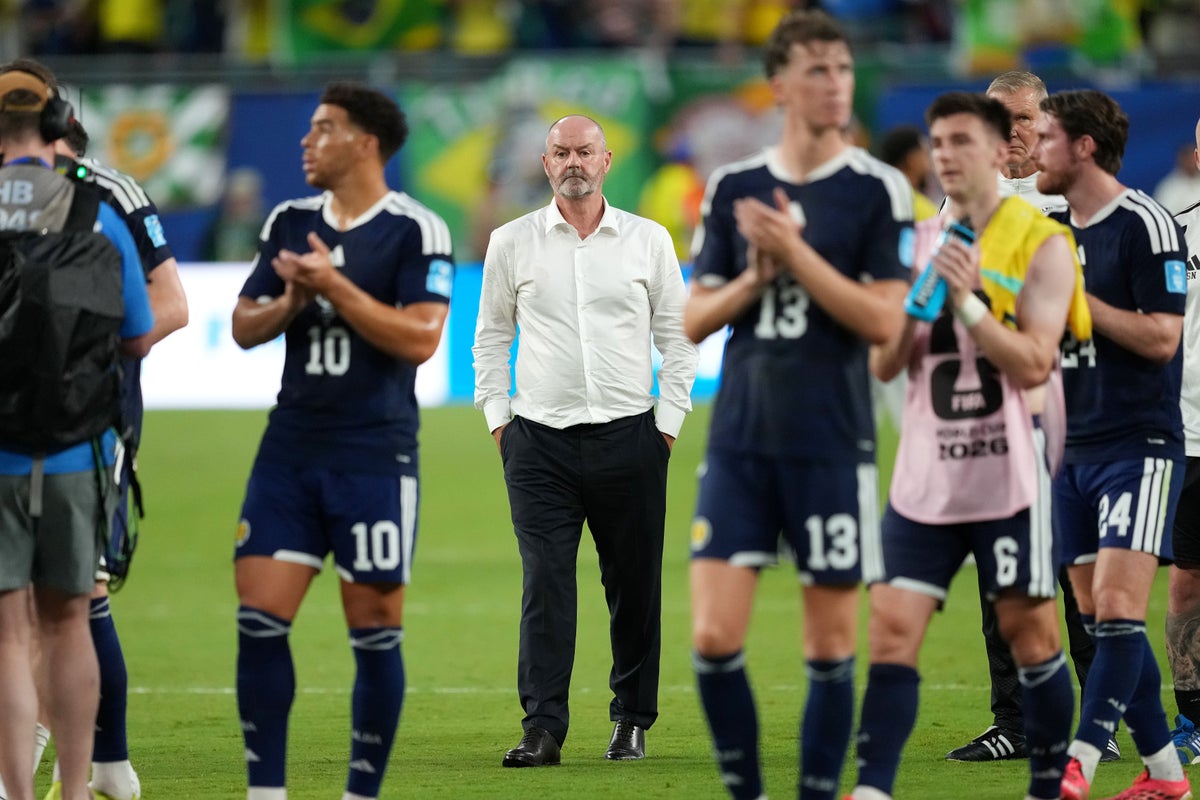
And there was the cumulative effect. This was a third tournament under Clarke, a third laced with disappointment. Some of the numbers – one win, three goals and five points from nine games – are unflattering. Beyond beating Haiti there was scant sense of progress. Nor was there enough of an identity. The spirit in the stands was not always mirrored on the field. It is therefore unsurprising that the manager felt he could take the team no further, stepping down immediately after their exit was confirmed.
Haiti scored twice as many goals as them and showed attacking verve against Morocco. Scotland did not. Going 200 minutes without a shot on target – from John McGinn’s winner in Boston through to the loss against Brazil – was damning.
Yet Scotland were also a defensive team who made defensive errors. They took it in turns: Grant Hanley for Morocco’s goal, Scott McKenna for Brazil’s opener and Jack Hendry for what seemed a second, even if he was lucky to be reprieved by VAR. And that was just the centre-backs.
If it underlined the lack of high-class central defenders, the last two tournaments have also shown that, Aaron Hickey apart, there are issues at right-back. Nathan Patterson against Vinicius Junior always threatened to be an unfair contest. It was.
In goal, the fact Angus Gunn did not start a league game all season illustrated the paucity of the options. Nor, really, have Scotland had quality strikers this century; though that made the omission of Oli McBurnie, after his outstanding season with Hull, all the odder.
As ever, Scotland needed their small band of elite players to prosper. They didn’t really. McGinn at least got a goal. Scott McTominay, far less dynamic than for Napoli, did not. But Clarke hampered him by using him in too deep a role against Haiti.
And that conformed to a theme. Too many times over three tournaments, the manager has picked the wrong team. Going 4-4-2 against Haiti may have been designed to be bold, but stifled McTominay. Using Kieran Tierney on the left wing against Morocco was unexpected and unsuccessful. Choosing Lawrence Shankland as a lone striker against Brazil scarcely worked.
Managerial decisions were compounded by players’ performances. Who actually had a good World Cup? Lewis Ferguson did, but not too many others. Ben Gannon-Doak showed promise. But whereas Andy Robertson said before the Haiti game that Scotland wanted to have “no regrets” when they went home, many a player should harbour them.
For an ageing team, it may be the only chance. The decision to give Clarke a four-year deal feels stranger and stanger. His stalwarts might make Euro 2028, but an overhaul beckons: by the next World Cup, Robertson, McGinn, Hanley, Hendry, Ryan Christie and Kenny McLean will be at least 35, Tierney, McTominay, Shankland, Lyndon Dykes, Che Adams, John Souttar and McKenna 34 or 33 and Craig Gordon a mere 47. There is already a case to move on some: McLean, the unexpected hero from the half-way line against Denmark in the play-off, was fortunate not to be sent off against Haiti.
Nor is there much evidence of too many successors to the Clarke generation emerging. The luckless Billy Gilmour can return after injury ruled him out of the World Cup. Tyler Fletcher, who got a call-up as a teenager, Lennon Miller, Findlay Curtis and Gannon-Doak could figure more. But none is a striker, defender or goalkeeper. A broader problem, far bigger than Clarke, is that the flow of Scottish talent that seemed a constant for much of the 20th century, has largely dried up.
They could look to emulate some sides who had more success in the World Cup and tap in to the diaspora; or to do so further, given McTominay and Fletcher were among those born south of the border. That could be seen as a sticking plaster, though: the more meaningful difference would be if Scotland could produce more technically-gifted, physically powerful players.
In the meantime, if the Scots are strangers to international tournaments, they have done their bit for international relations. There should be more Bostonians on the banks of the Clyde, in reciprocal visits. But if there are not Scots in Spain in 2030 or Saudi Arabia in 2034, they will have longer to lament the struggles of their team in the United States.