
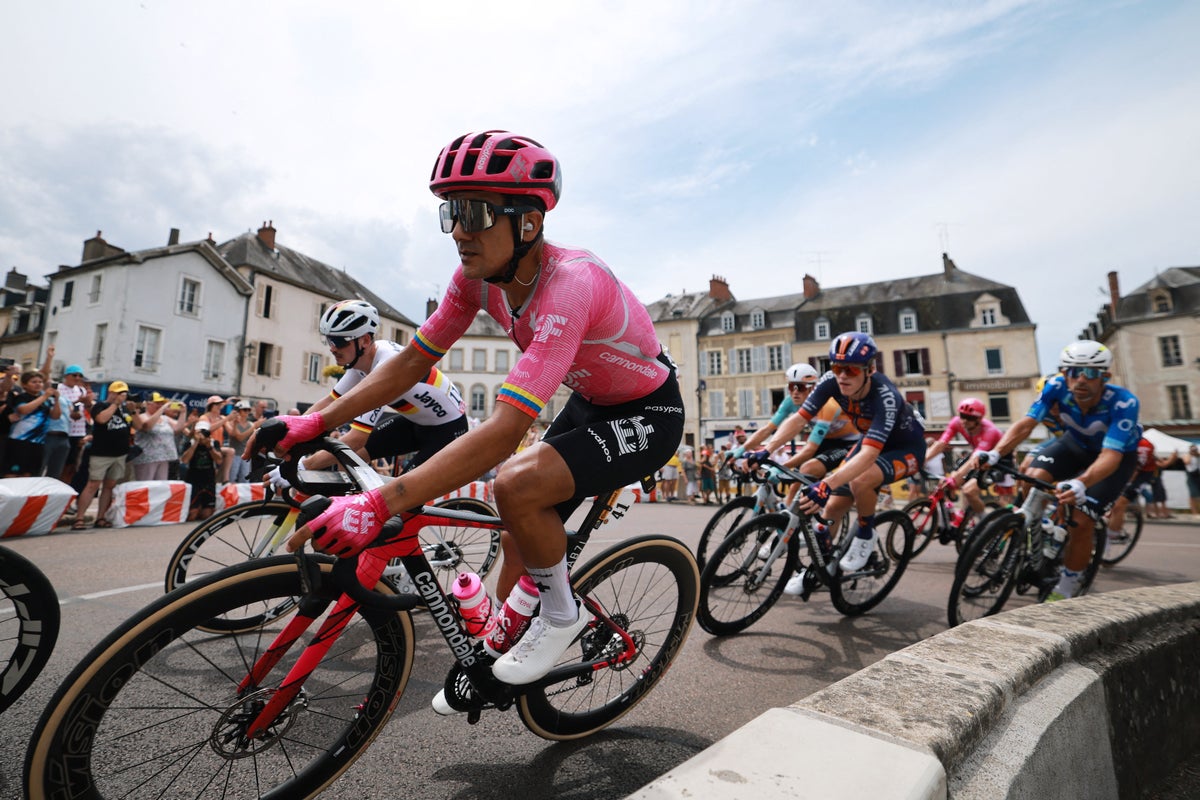
Away from the general classification battle on the Tour de France there are a dozen other skirmishes going on. For American world Tour team EF Education-EasyPost, it’s the fight for stage wins which is most significant. The team’s Tour de France squad includes two of the most instinctive racers of this era, Ben Healy and Richard Carapaz, as well as other riders noted for their ability to get into breakaways and make moves stick against all odds, like Kasper Asgreen.
The eight riders travelling through France are shepherded by a host of sports directors, mechanics, soigneurs and other support staff, with the whole operation masterminded by ex-pro and general manager, Jonathan Vaughters, all in the hope of that rare beast, a stage win in cycling’s most prestigious race.
Speaking to The Independent, Vaughters likens running a cycling team to a military campaign: “There’s the behind-the-scenes people that are essentially your supply line for your front line, the riders, there’s a chain of command going on and there’s communications from the coaches up to the riders during the race, there’s an overall strategy that is dictated by me. So it’s a mobile logistics operation where we’re going out and, you know, fighting a battle every day.”
That “battle” analogy feels fitting: EF as a team specialise in the kind of swashbuckling, attacking riding that is increasingly being squeezed out of cycling. The Independent speaks to Vaughters on the morning of stage 10, a tough, hilly day finishing in Le Lioran, where Jonas Vingegaard pipped Tadej Pogacar in a sprint finish in 2024.
EF manage to get the in-form French rider Alex Baudin, who finished fourth from the breakaway on stage nine in Ussel, into the day’s break. But UAE Team Emirates-XRG, the team of race leader Pogacar, give fierce chase behind and keep the escapees on a tight leash, while Dutch powerhouse Mathieu van der Poel is unstoppable in the finish.
Is UAE’s dominance a source of frustration for other teams? Vaughters is pragmatic about it: “To get frustrated about it is a waste of time. But I would say it magnifies an issue that the sport has, which is, quite simply, like a team like UAE can afford whatever the rider they want on the transfer market because their payroll budget is essentially unlimited.”
UAE’s squad is built around Pogacar but also contains a serious podium contender in Mexican starlet Isaac del Toro, who was second in last year’s Giro d’Italia and currently sits third overall.
The financial disparity is enormous: Vaughters is confident that UAE’s eight-man Tour de France squad are earning nearly double EF’s entire 30-man team. According to La Gazzetta dello Sport, budgets for a team like UAE are around or above €50m (EF have previously said their own budget is average for the World Tour, so around half that figure).
Vaughters estimates that for most teams rider salaries account for around 50 per cent of a team’s budget, which is likely to be closer to 60 per cent for UAE, “simply because their logistics costs are not going to rise exponentially or parallel to the rider costs”. It gives them a staggering amount to spend on accruing, and keeping, top talent.
So how do you compete against a team like that? You try to acquire some financial muscle of your own. Education First, the Swedish education and language company, which is EF Education-EasyPost’s primary sponsor, is open to relinquishing the team’s naming rights in the hope of securing more extensive financial backing. That, hopefully, will take the team closer to UAE budget-wise – to more like 75 per cent of their budget, Vaughters estimates, as opposed to where they currently are, operating at around 40 or 50 per cent.
Another thing Vaughters is hopeful cycling could introduce is some kind of financial fair play system, to try to even the playing field behind those teams with “government money” like UAE and those still run the more traditional way, with sponsorship by large but not state-funded companies. Vaughters points out that the huge wealth disparity, and dominance by one team, “detracts from the fan experience”.
But will anything really change? Cycling is a deeply traditional sport with power concentrated in the hands of companies like Tour de France organisers ASO, who own the majority of the sport’s top races and are known for a conservative approach, and trying to get the myriad stakeholders, teams, governing bodies and riders’ unions to agree is much easier said than done.
Vaughters says: “I think a lot of times cycling loses out because of infighting amongst the various parties inside the sport. In theory, the teams should all be pretty aligned in what their interests are in this, but that’s not entirely the case.”
Which brings us onto another issue which seems to be permanently up for debate: the calendar, which as it stands is a mish-mash of races which often clash or overlap. Vaughters says: “Cycling has spent 100 years of growing very organically, and it has not grown strategically.”
He contrasts it to Formula One, which has a straightforward season-long narrative, with drivers and teams accruing points throughout each race that contribute to an overall championship. “That’s a lot easier for fans to follow, and the season builds on itself. It’s the same people battling week in, week out, which really establishes a consistent fan base. F1 clearly is designed to be an audience-friendly sporting event. I think for cycling to be competitive with these other sports, the calendar needs to be redesigned in a strategic sense, not in an organic sense.”
The counterpoint to this is that cycling, held on open roads in the world’s biggest and most accessible arena, doesn’t struggle for fans. But there are other reasons why the calendar may need a redesign: one of the big stories of this Tour, and one which can no longer be ignored in the wider sport, is the existential threat of extreme heat and the climate crisis.
A 40C heatwave in central France in the opening week forced stage nine to be shortened, while wildfires meant the finale of stage three had to be raced with no spectators at the roadside. Pogacar has been among those to call for the calendar to be changed to avoid racing in the summer months, with broiling temperatures putting riders and crowds at risk.
As with anything in the sport, progress, if it happens at all, will be slow. Vaughters says: “Short term, maybe there’s some simpler measures, [moving] the races either quite a bit earlier or quite a bit later in the day [to avoid the worst of the heat].” Even that would run into opposition: “I know there’s commercial interests that don’t align with that, from a television audience standpoint.”
The heat is having a bigger impact on certain riders than others: Irishman Healy was the animator of last year’s Tour, taking the yellow jersey and winning a stage while lighting up breakaways, but his season has been hampered by injury and illness, and the searing heat has done him no favours. “He’s kind of waking up every day hoping it’s going to rain, and so are we,” Vaughters jokes.
Four stages remain on this Tour, and for all EF’s efforts, that stage win remains elusive. But a trio of gruelling mountain stages offer more opportunities to get up the road and try to stave off UAE. For the underdogs, it’s the sort of chance they relish. And by the time the next Tour rolls around, rather than trying to undercut Pogacar, they could be competing on a level playing field.