

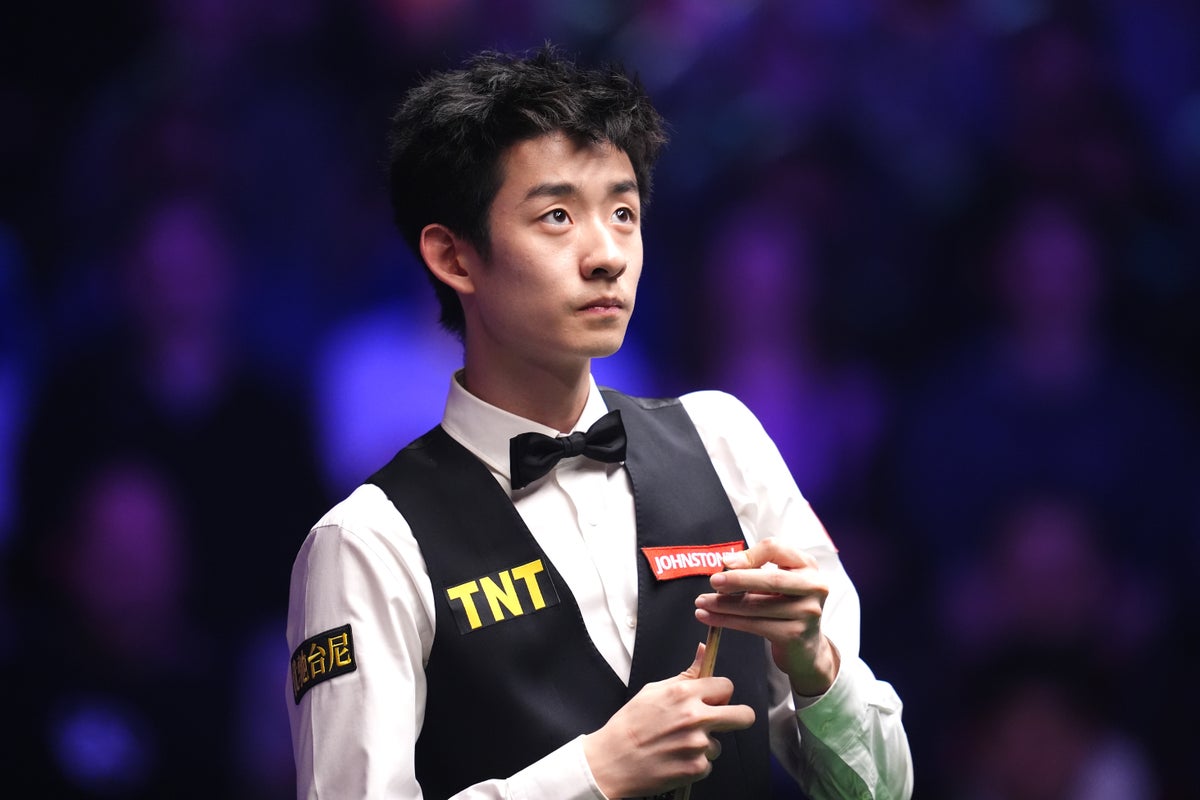
Wu Yize hails from Lanzhou in the northwest of China, a city famous for its beef noodles. It is a clear beef broth with radish slices, chilli oil and herbs, and aside from his family, it is the thing he misses most: there are plenty of Chinese restaurants in Sheffield, but they don’t do it like home.
It is a small cost for being one of the best young snooker players in the world. Wu moved his life to Yorkshire three years ago to be part of the growing stable of Chinese players in the city, and he could be the next superstar from the group. The 22-year-old reached finals at the English Open and Scottish Open last season, and comes into the World Snooker Championship as the 10th seed and among the contenders for the title.
He is another player off China’s impressive production line, like Zhao Xintong before him, who became the first Chinese world champion last year. Behind Wu comes Lan Yuhao, a precocious 17-year-old already impressing in his nascent career.
Wu was a natural talent at a young age. His mother ran the family antiques business while his father spent time taking him to snooker tournaments and nurturing his talent. Aged 11, his dad took him to the Yushan International Billiards Academy to be seen by the renowned Australian coach Roger Leighton.
“When he came to me, his highest break was 49,” Leighton tells The Independent. “After a couple of weeks, he hit an 86. I said, ‘That’s great, amazing.’ He said, ‘It’s no good, because Ronnie would have cleared up.’ That’s his mentality. But he was a fun-loving kid. If he missed a ball, he hated it, but he laughed a lot, and that was his way of releasing pressure.”
There were some technical issues to iron out. Wu’s arm would drop through his takeaway and his wrist would move as he pushed the cue through. “He had a few big problems for consistency,” Leighton says. “He would miss too many easy balls.”
But Wu improved rapidly and won the Under-21 World Championship, aged only 14. At 15, he pushed John Higgins to a deciding frame before going down 6-5 at the 2019 International Championship in China. Wu turned professional at 17 and made it to the Crucible at 19. His first ranking title came at last year’s International Championship, beating Higgins in the final.
Wu delivered a whirlwind of potting and break building in Nanjing that week, in front of his parents watching on, scoring 14 centuries in 63 frames. He was 4-0 down to the world No 1 Judd Trump in the last 16, in a race to six, and proceeded to win six frames on the bounce. He kept up the streak to knock out Barry Hawkins 6-0, before beating world champion Zhao in the semi-finals.
After the final, Higgins paid Wu a huge compliment. “He reminds me so much of the late, great Paul Hunter, the way he plays the game. He’s a new superstar.
“I’m delighted his mum and dad are here. It brings back memories for me. It could open the floodgates. It goes to show the good hands snooker is in. I’m glad that I’ll probably be retiring in a couple of years with guys like that potting them off the lampshades. He is a total star.”
Asked about the comparison, Wu smiled: “Paul Hunter was a really good-looking guy.”
Higgins is not the only player to have been impressed by Wu’s talent. Shaun Murphy tipped him to be a future world champion, and Ronnie O’Sullivan likened Wu to a “more dynamic” version of Steve Davis. “I practised with him for two or three days in Hong Kong,” O’Sullivan said. “It’s not until you practise with someone that you can really appreciate how good they are. After day two, I was like, ‘This kid is really special’.
“I think he is going to be world No 1; I’d give him three years. He’s definitely going to be world champion very, very soon … I’d just love to go and see him fulfil his potential as a professional. I expect him to do a lot of great things in snooker.”
Leighton agrees. “I think he could be world champion in three to five years, and definitely world No 1. He punishes mistakes, he scores well. He didn’t get into the top 16 as soon as he wanted, but he’s got there. He is slowly creeping up, and now he’s won a tournament, he’s very confident. If he can get one or two more wins, he’s going to be a real threat. He’s beaten Zhao, and not many people can say that.”
And Leighton points to another hidden strength. “He has a special mentality, to be able to do it under pressure. He feels nerves, but it’s a different mentality; it’s a cultural thing, built into [Chinese players]. I’ve seen them playing matches, knocking in long balls, big breaks, and then they say, ‘I felt so nervous, I was shaking.’ And I think, really?”
Wu may be honing his talent a long way from home, but his family is never far away. When he was struggling with a damaged tip during his impressive debut at the Masters in January, Wu’s father flew all the way from Lanzhou to Alexandra Palace to help fix it.
“My parents are everything,” Wu said. “My dad has been with me since I was a kid, always by my side. He’s helped me so much, especially during difficult times in the UK. I’m so grateful for what he has done for me.”
He is still yet to win a match at the Crucible, but this year could be different: he is the youngest player in the world’s top 16, and the seeding means his first game is against a qualifier, fellow Chinese 22-year-old Lei Peifan.
There is still an intimidating list of world champions lining his potential route to the final, with Mark Selby, Judd Trump and Mark Williams among the possible opponents in the next rounds. But Wu has a long list of big-name scalps already in his career, and they will not relish meeting one of the game’s rising talents, in his hometown from home.