

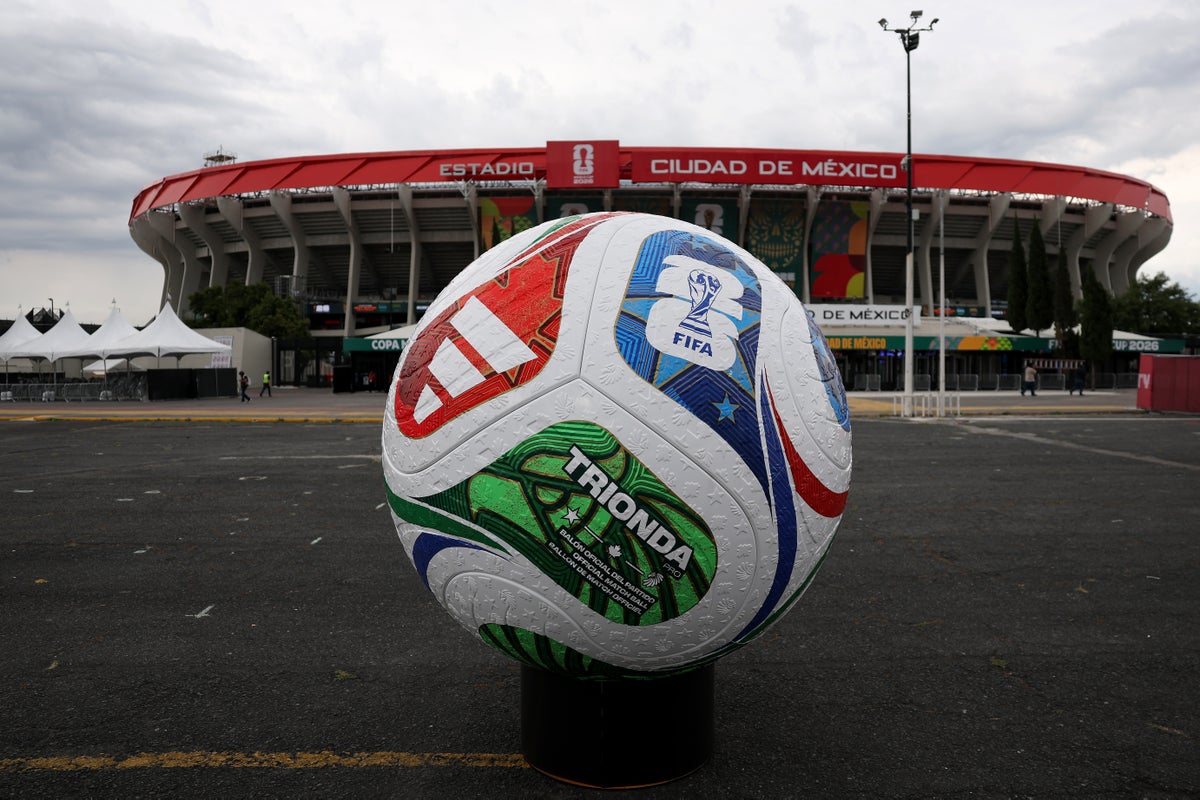
There are a few parallels that can be drawn between the World Cups of 2026 and 2010. Both kicked off with the same opener: South Africa vs Mexico. Both harnessed an irritating droning noise we couldn’t get rid of: South Africa had the vuvuzela, North America has Alexi Lalas. But there’s an emerging shared trait that threatens to disrupt this tournament, just like it did 16 years ago. Once again, the ball is becoming the story.
No football exists in greater infamy than the Jabulani. Its ultra-smooth design with just eight thermally-bonded panels created the most unpredictable World Cup ball ever seen. Loathed by the many, including all goalkeepers, it was also mastered by the few.
Diego Forlan became synonymous with the Jabulani, though this was not by fluke. His former Uruguay team-mate Sebastian Abreu said he asked Adidas to send him the ball three months before the start of the World Cup and would spend time after Atletico Madrid training learning its quirks. “A lot of practice, a lot of training and again a lot of practice,” reflected Forlan, who went on to score five in South Africa to claim a share of the golden boot.
Those who watched the 2010 World Cup have that ball burned into their memory, but its legend is repeating itself.
Another football fiasco is brewing. Out with the Jabulani, in with the Trionda.
On numerous instances has the same type of goal flown in during the first two rounds of the group stage. They all relate to rising, driven shots that go above shoulder height, and are often not heading right for the top corner. Goalkeepers are diving across to save these shots and are crucially getting a hand to the ball – but when they make contact, it’s not in the right place and the ball simply passes through, as if they’ve misjudged the flight.
This happened to England’s Jordan Pickford against Croatia, who got to Martin Baturina’s effort but failed to keep it out. Algeria’s Luca Zidane and Senegal’s Edouard Mendy also endured similar goal-allowing incidents in their nations’ openers. Now Iraq’s Ahmed Basil let Kylian Mbappe breach his defences in the same manner, making the distance only to parry the French superstar’s shot further into the corner rather than away from his goal.
You can point the finger at the keepers’ inadequacies if you like, but those in the know think something greater is at play.
“I’m seeing this goal way too many times for a World Cup for there not to be something up with that football,” former England international goalkeeper Joe Hart said in a piece of passionate half-time analysis during France’s 3-0 win over Iraq on Monday night. “As soon as they’re not using the curling technique, as soon as that ball is not moving, it’s not spinning, the goalkeepers are struggling.
“Watch the ball, the trajectory of it: it’s not moving. Now that’s not right in the corner, and this is not me coming for the goalkeeper because I’ve seen it happen with Mendy, Zidane, Pickford. They just cannot seem to their timing of this World Cup football [right], anything above shoulder height that’s not a curled effort.
“He’s got enough time – a World Cup goalkeeper can get a step in here and dive, but it seems like it’s on him before he’s even ready to make contact. I was speaking to Gael [Clichy] during the first half and saying, ‘How many times at top level do you see the goalkeeper touch it and it go in the goal?’ Very rarely, because they’re good enough to once they do get contact, they get it wide. I’m noticing in this tournament that goalkeepers are getting touches on it above their shoulder height, and they’re just not able to keep it out, so something’s up.”
Hart’s suspicions of dodgy ball mechanics are backed by scientific research done before the World Cup began. The Trionda is the first to be made up of just four panels, which means less total seam length and, therefore, a smoother ball. Adidas counteracted this by intentionally deepening the seams while also adding three pronounced grooves to each panel, along with fine surface texturing.
This should make it more predictable. But after tests at the University of Tsukuba, it was found that when the Trionda is in the air at higher speeds, it loses range and can descend sooner than previous World Cup balls usually would.
The Jabulani had a different, more fundamental problem. If it was kicked with a little bit of spin, it slowed down too much as it passed through its “critical-speed range” – where airflow around the ball changes from one state to another, which can cause the alteration of its acceleration and trajectory. This trait intensified the Jabulani’s knuckle, making it far more noticeable.
While the Trionda’s quirk is less obvious, this element of unpredictability with the ball is clearly great enough to catch goalkeepers out, something Hart drew attention to. He highlighted the “brain calculation of a goalkeeper” and the tiny margin for error that stoppers develop at this high level. “In this tournament, they’re getting set and they’re flying after it, and it’s just not matching up with what they’re doing daily,” he said.
What this means is piledrivers will keep flying in this summer, pushed further into the top corner by goalkeepers whose calculations are out of sync. The neutral fan will probably see this as a good thing.
But will the Trionda have as great of a cultural impact as the Jabulani?
No. Its pitfalls are far less sexy than its 2010 predecessor – who could get bored of endless knuckleballs? The repetition of somewhat blameless goalkeeping errors, on the other hand, is already growing very tiresome.