

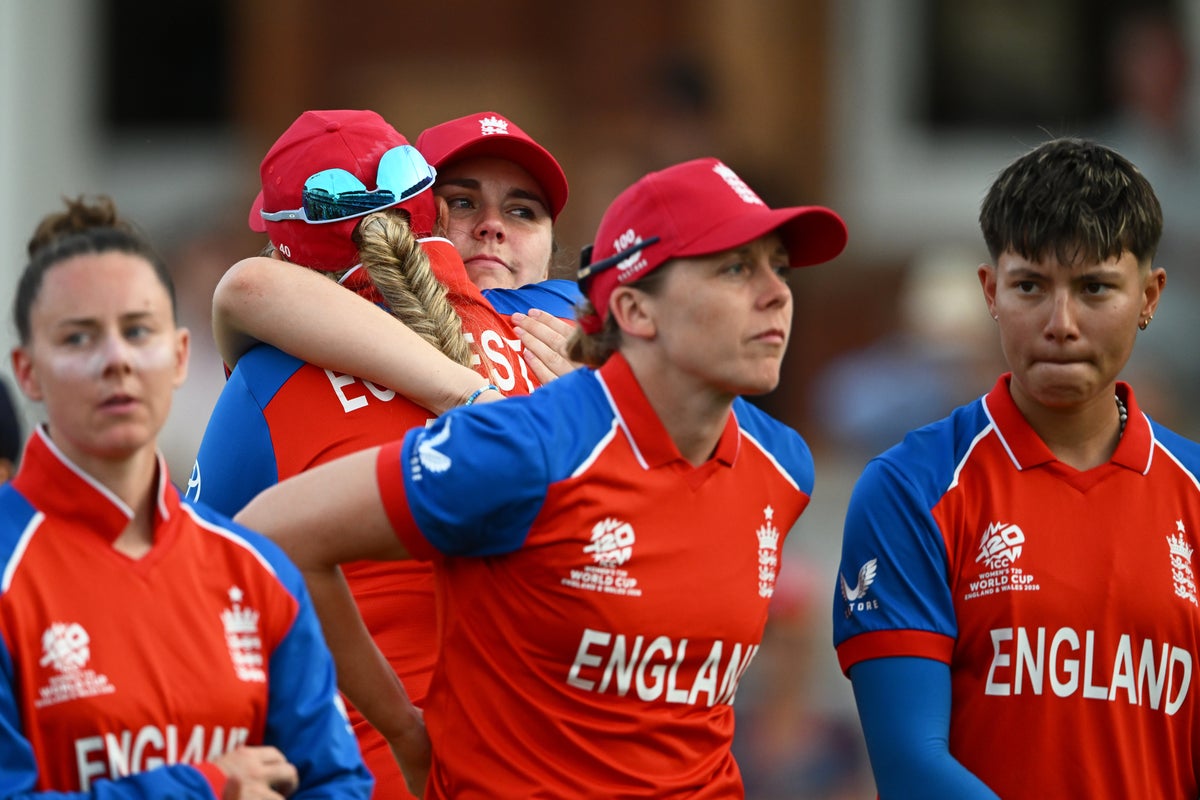
England’s new era received a reality check as they were soundly beaten by Australia in the ICC Women’s T20 World Cup 2026 final, but head coach Charlotte Edwards refused to feel anything but pride.
Australia were back to their fearsome best with a seven-wicket win to spoil the party at a sold-out Lord’s, as England could not match performances that saw them go unbeaten en route to the final.
Beth Mooney’s match-winning 64 meant England have lost a home World Cup for the first time and are still searching for a second T20 World Cup, with Edwards the captain the last time they lifted the trophy, also at Lord’s.
Meanwhile, Australia, who are also undergoing a transformation under new skipper Sophie Molineux, claimed a record-extending seventh T20 World Cup, keeping up their record of beating England in every final in which they have played them.
“When I got this job, I spoke to the players about changing the perspective of the team and how people are talking about this cricket team is really pleasing and something that makes me really proud,” Edwards said.
“They have played with so much pride for the shirt, they have had energy, and smiles on their face and they have absolutely loved it.
“I am sure there will be some sad faces around, but I couldn’t be prouder of them; it has been wonderful to watch them all grow.”
The tone for the showpiece was set when Amy Jones became youngster Lucy Hamilton’s first World Cup wicket, going for six having been caught well down low by Georgia Voll.
Hesitation between Nat Sciver-Brunt and the tournament’s leading run-scorer Danni Wyatt-Hodge was about to turn to suffocation until England accelerated, hitting Annabel Sutherland for 12, including sending a free hit to the boundary.
The Aussies were always on top, though. Wyatt-Hodge was dismissed for eight on review by Sutherland, with Player of the Final and the Tournament Beth Mooney holding on to a nick at the second attempt.
It took England 22 balls to score their next boundary before Alice Capsey targeted Ashleigh Gardner in the ninth over, taking her for two fours and a six, but it was almost already too late.
Capsey survived a review for LBW, but Molineux had her wicket three balls later, bowling her for 23 on an attempted reverse sweep, something Australia had clearly planned for.
England, under Edwards, had learned how to time or rebuild an innings, but here they were utterly stifled by Australia’s detailed plans, although the coach also said the pitch simply was very difficult to bat on, evidenced by Sciver-Brunt’s slow scoring.
The skipper was joined by Heather Knight, with whom she had made 133 runs in the semi-final, but this time, Knight was given out LBW on review for two, and England slipped to 70 for four.
The captain refused to take a risk, going 11 overs without a boundary, and only brought up her 50 in the 18th over, her ninth at T20 World Cups, a record that Mooney later matched.
Freya Kemp instead provided the fireworks to push England to 150 for four, Sciver-Brunt ending on 58 not out as her side set Australia the highest chase in a T20 World Cup final.
Australia looked undaunted as Voll crashed the first ball for four before Lauren Bell bowled a no-ball that missed the cut strip and went to the boundary.
The pace bowler responded by bowling Voll for nine and roared almost as loudly as the 28,887-strong Lord’s crowd, who had had precious little to cheer.
But the damage had been done, and no bowler was safe as Phoebe Litchfield reverse-swept Linsey Smith for six before Mooney brought up her fifty off 38 balls.
Litchfield fell two runs short of her own half-century as Charlie Dean bowled her for 48 from 35, and the mini fightback continued as Mooney was given out on review for LBW off the bowling of Ecclestone, having made a match-winning 64 from 49.
Ecclestone was then incensed as her incredible diving catch to dismiss Ellyse Perry was ruled not out, and she suffered the fate of conceding the winning runs, fittingly for England’s day, they were five wides.
Despite the misery at Lord’s, Ecclestone is arguably the standout example of the growth under Edwards.
Her bowling has always been exemplary, but her fielding in the knockout stages was acrobatic, a key marker of how England have improved their fitness, which let them down in their Ashes whitewash and group-stage exit of the 2024 T20 World Cup.
Edwards added: “We are probably further than where I thought we would be, certainly in the T20 stuff, the way we played has been really pleasing.
“The way the players have dealt with the pressure, the expectation of being the home team, it has been some really pleasing stuff and has built on what we set out to work on over the last 12 months.”
England have certainly been a more confident team than when the stuffing was knocked out of them after the Ashes.
After the final, Sciver-Brunt was tearful as she reflected on the loss, but was big enough to admit they were outplayed on the day.
While Edwards revealed that she was content with the way the tournament had gone, even if it ended without the trophy.
“You have got to be really assured of what you are trying to do and there is nothing I would change in terms of our prep and everything we have done in this tournament,” she said.
“I can sit on that balcony tonight and say I have done everything I possibly could to get hopefully a World Cup win at Lord’s.
“We know the standard. We have seen it today, and that will only drive us forward and motivate us even more.”
Ominously, Australia will be looking to repeat the cycle which has seen them twice win the T20 World Cup three times in a row after losing it.
And Molineux believes there is more to come from her team, who dominated all those who tried to tame them.
The Australian skipper said: “We’re always in the business of trying to get better. I’m sure we definitely will celebrate this. And it rolls on pretty quick after this, and we don’t think we’ve reached any ceilings yet.
“This team has got generational talent from young girls like Lucy Hamilton right to the end of the spectrum with Ellyse Perry, Beth Mooney.
“I think we’re in this really beautiful spot where it’s shared, and everyone wants to play for each other, and they’re committing fully to how we want to play. Long may that live.”