

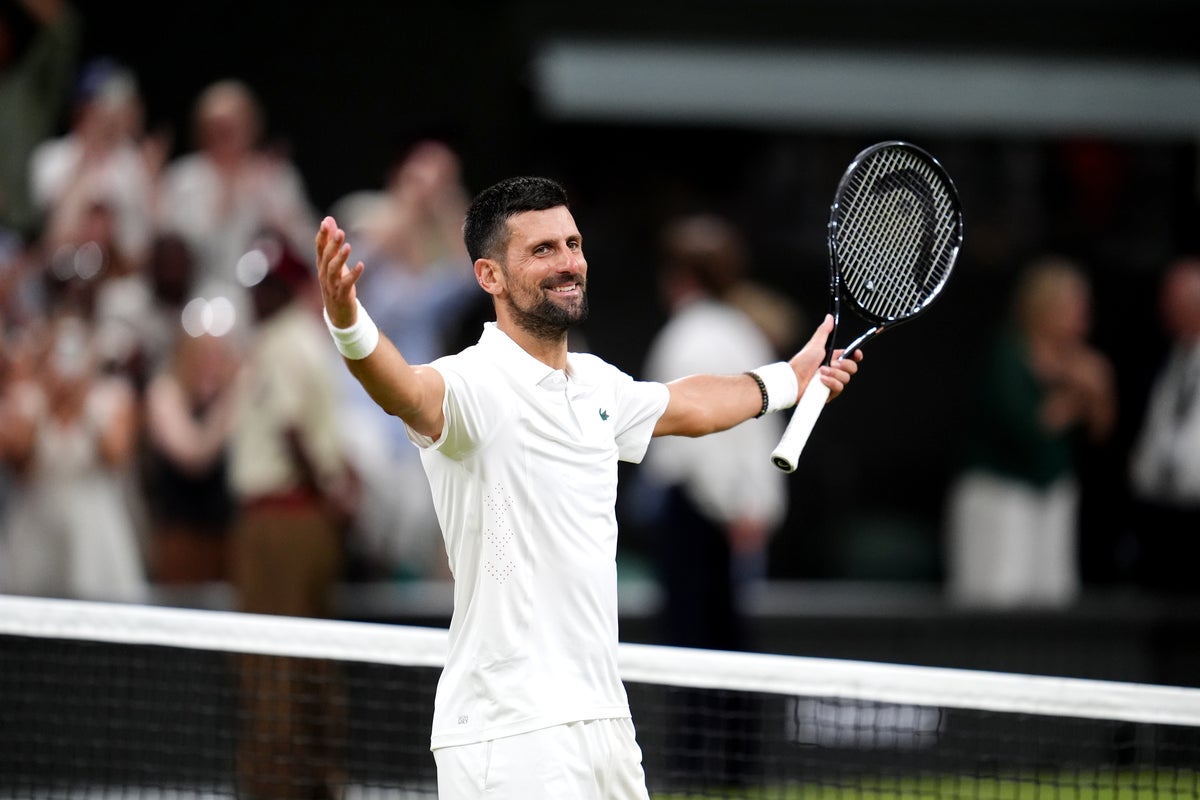
There were more than five hours on the clock and yet Novak Djokovic was still not done. As Centre Court shook, Djokovic’s 11-year-old son, Stefan, watched on with his head in his hands, up way past his bedtime but gripped by what his 39-year-old father was producing. Felix Auger-Aliassime stood over a forehand and sensed his moment to strike but Djokovic, in a flash, sprung to his right deep behind the baseline, extending the point and the Canadian third seed’s torment. Auger-Aliassime netted and it broke him; the decisive point in the match tiebreak that settled the longest Wimbledon quarter-final ever, a victory that Djokovic ranked as one of his finest ever on Centre Court.
“These are the moments I still play for,” said Djokovic. If the scoreline – 7-6 (10), 3-6, 6-3, 6-7 (4), 7-6 (10-4) – is scarcely believable in itself, the sight of Djokovic stretching his limbs and denying the 25-year-old Auger-Aliassime in five hours and 15 minutes, was sheer madness. It equalled the longest match of Djokovic’s Wimbledon career, eight years on from the 2018 semi-final with Rafael Nadal that was held overnight. Djokovic managed this in one epic, gruelling sitting just five minutes before the 11pm curfew. When the moment required it, he once again raised his level, booking a semi-final with defending champion Jannik Sinner on Friday.
The celebrations were memorable, the victory too – a battle Djokovic prevailed from in front of his children on Centre Court adding to the sweetness. And yet the message afterwards from Djokovic was that he is not done yet. The records – an eighth consecutive Wimbledon semi-final, the 15th of his career – did not matter. “Right now, it’s all business,” Djokovic confirmed. The pursuit of the grand slam record and a 25th title is what fuelled his extraordinary fight and refusal to submit, and yet it is still two rounds away. ”I wish it was finals so I don’t need to worry about how the body will feel tomorrow,” Djokovic said.
And there could lie the problem. At this stage of his career, and since the gold medal match against Carlos Alcaraz at the 2024 Olympics, Djokovic’s finest victories have arrived before the final. Last season, the quarter-finals of grand slams fell in the the sweet spot where Djokovic was fresh enough to compete against younger opponents, but late enough in the tournament where he knew he needed to step it up. He did, in defeating Carlos Alcaraz at the Australian Open, Alexander Zverev at the French Open, Flavio Cobolli at Wimbledon and Taylor Fritz at the US Open. Outlasting Auger-Aliassime at Wimbledon is another added to the list.
Djokovic, though, arrived at those semi-finals and found that he was physically cooked, unable to recover for the next challenge. The exception came at the Australian Open in January, and was memorable in itself with Djokovic ending Sinner’s reign in Melbourne by beating the world No 1 in five sets. But that followed a different sort of tournament for Djokovic, after his fourth-round opponent Jakub Mensik withdrew and Lorenzo Musetti retired from their quarter-final due to injury while leading by two sets. Djokovic arrived into his semi-final with Sinner fresher, but after he prevailed he still ran into Alcaraz in final, where he eventually ran out of gas.
Djokovic will have an extra day to recover before he plays Sinner on Centre Court on Friday in a rematch of last year’s semi-final. It may prove to be invaluable. “Let’s see. Let’s see,” Djokovic said. “I have an extra day, which is good.” Sinner, by comparison, has won his last four matches in straight-sets and has not been pushed past the three-hour mark since his opening-round scare against Miomir Kecmanovic last week. Djokovic, meanwhile, has only played one match in under three hours. Djokovic may be matching the heroics of fellow 39-year-old Lionel Messi, yet he wished he could play 90-minute matches like him, too.
And it is the brutal reality of sport that there is no trophy for Djokovic for reaching another semi-final, or for Auger-Aliassime for falling just a few points short in one of the greatest matches in Wimbledon history after five hours and 15 minutes. But in another sense, tonight felt as if the recognition for Djokovic and his latest victory against the younger generation actually could have been enough, with Centre Court rising to its feet for the match tiebreak and this marathon quarter-final. “I still want to go at least one more step further,” he said. “But this was as good as a final for me.”
There was no doubt, however, that Djokovic, the man who has nothing to prove, once again left behind something special on Centre Court. “Another great, historic run for me at the grand slams,” he said. “This is what counts the most, honestly. I still try to prove to myself and others that I’m able to compete with the best players in the world and beat them on the biggest stage. That’s what I’ve done in Australia. It’s what I’ve done here. Hopefully I can do it in a few more matches here.”