

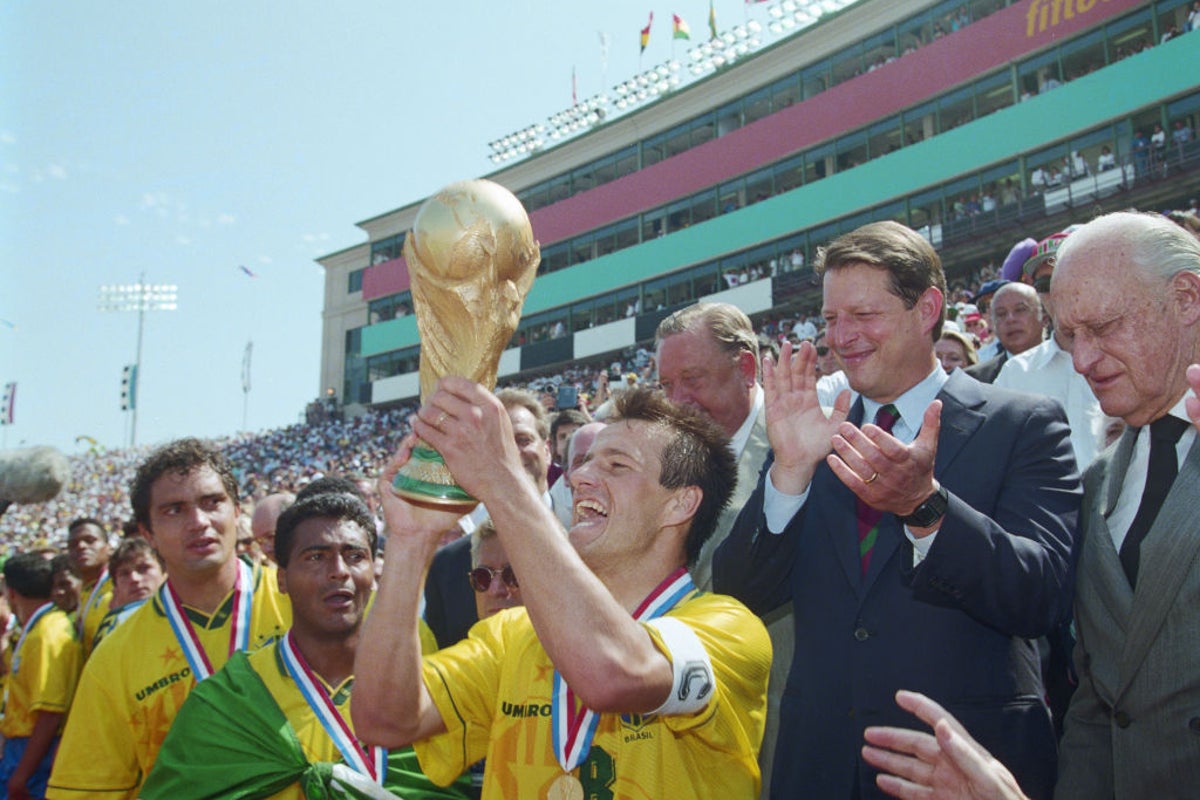
The United States hosted its first World Cup in 1994.
Soccer has changed dramatically in many ways since then – on and off the pitch.
As the US (with Mexico and Canada) gets set to host the mega-event once again, more than anything, the tournament’s defining change since 1994 is its sheer scale-up.
The scale-up
This scale-up can be clearly quantified. The 1994 tournament featured 52 matches across 32 days with 24 teams. By contrast, the 2026 event (the first three-nation World Cup) will involve 78 matches in the US alone, over 39 days.
The competition’s 48 teams are divided into 12 groups, with progression to the knockout stage awarded to the top two teams in each group along with the eight best third-placed teams.
In terms of games, the tournament has doubled in size since 1994.
The scale-up is not accidental. It has been driven by the twin forces of globalisation and commodification, alongside a deliberate strategy by FIFA president Gianni Infantino to both protect and extend football’s commercial dominance.
Central to this has been expanding the tournament into non-traditional markets, most notably the US – the world’s largest sports economy – thereby generating substantial financial returns and commercial interest.
Infantino and FIFA have faced sustained criticism in global media – ranging from controversial symbolic gestures involving Donald Trump to concerns over ticket pricing. But the broader outcome is clear: the World Cup has become more expansive and commercially powerful than ever.
At the same time, FIFA has deepened its claim to global reach by incorporating smaller nations such as Cape Verde and Curaçao, whose combined populations are well under one million.
The scale-up rests on two core dynamics. First, more matches mean more broadcast content, and media rights remain FIFA’s largest revenue stream. Expanding to 104 matches significantly increases the value of rights deals, particularly across participating nations.
Second, expansion broadens FIFA’s political base. By granting more countries access, it strengthens the influence of nations previously on the margins of global soccer.
Within FIFA’s voting structure, each member association carries equal weight: the vote of powerhouse Brazil counts the same as that of Curaçao, a recent entrant with a population around 150,000.
At the same time, a larger tournament increases the likelihood that major population centres and emerging consumer markets (such as China, India, and Southeast Asia) will participate, further expanding the World Cup’s commercial reach.
The unresolved question for FIFA is one of limits: how far can expansion go before it dilutes the exclusivity and premium value of the World Cup?
The World Game in the US
Soccer in the US has grown markedly since the 1994 event. In many ways, this growth reflects the original intent behind awarding the 1994 World Cup to the States.
The 1994 tournament was still the best-attended in history, largely due to the use of National Football League (NFL) venues. It was granted on the condition that a viable professional league be reestablished following the collapse of the North American Soccer League in 1984.
Major League Soccer (MLS), launched in 1996, is now firmly established within the US sporting landscape.
The pathway has also strengthened, with college athletes feeding into MLS and increasingly major European leagues, alongside the expansion of secondary professional and semi-professional tiers.
Growth has been especially strong in the women’s game thanks to significant new investment.
The US men’s team, currently ranked 16th in the world, could plausibly make a deep run in 2026.
As in 1994, matches this year will largely be staged in football stadiums to maximise capacity.
Rule changes and technology
FIFA’s rule changes are largely designed to keep the ball in play and increase the tempo of matches. Measures addressing time-wasting – from stricter control of throw-ins and goal kicks to tighter management of added time – reflect this objective.
The 1994 World Cup introduced major reforms, including a ban on back-passes to goalkeepers and awarding three points for a win to encourage attacking play.
Looking to the 2026 event, technological oversight will expand, with Video Assistant Referee (VAR) technology applied more broadly to decisions such as second yellow cards and corner calls.
Player welfare has also become more prominent: after the extreme heat issues of 1994, mandated drinks breaks will be introduced – one in each half around the 22-minute mark.
Substitution rules have also evolved significantly, increasing from two in 1994 to five regular substitutions, along with an additional allowance for concussion replacements.
About the author
Steve Georgakis is a Senior Lecturer of Pedagogy and Sports Studies at the University of Sydney. This article is republished from The Conversation under a Creative Commons license. Read the original article.
Same game, different scale
Since its codification and even in early filmed matches more than a century ago, soccer’s simplicity has been the foundation of its global dominance.
The sport’s continuity bridges generations. The leading players of the 1994 World Cup, such as Italy’s Roberto Baggio and Brazil’s Romário, could plausibly compete in the modern game, even if today’s players are generally more physically developed.
Ultimately, despite the scale, global reach and commercialisation of tournaments like the World Cup, soccer’s enduring success lies in its consistency.
The game played on the world’s biggest stage remains fundamentally the same as that played in parks, schools and local grounds; simple, universal and instantly recognisable.